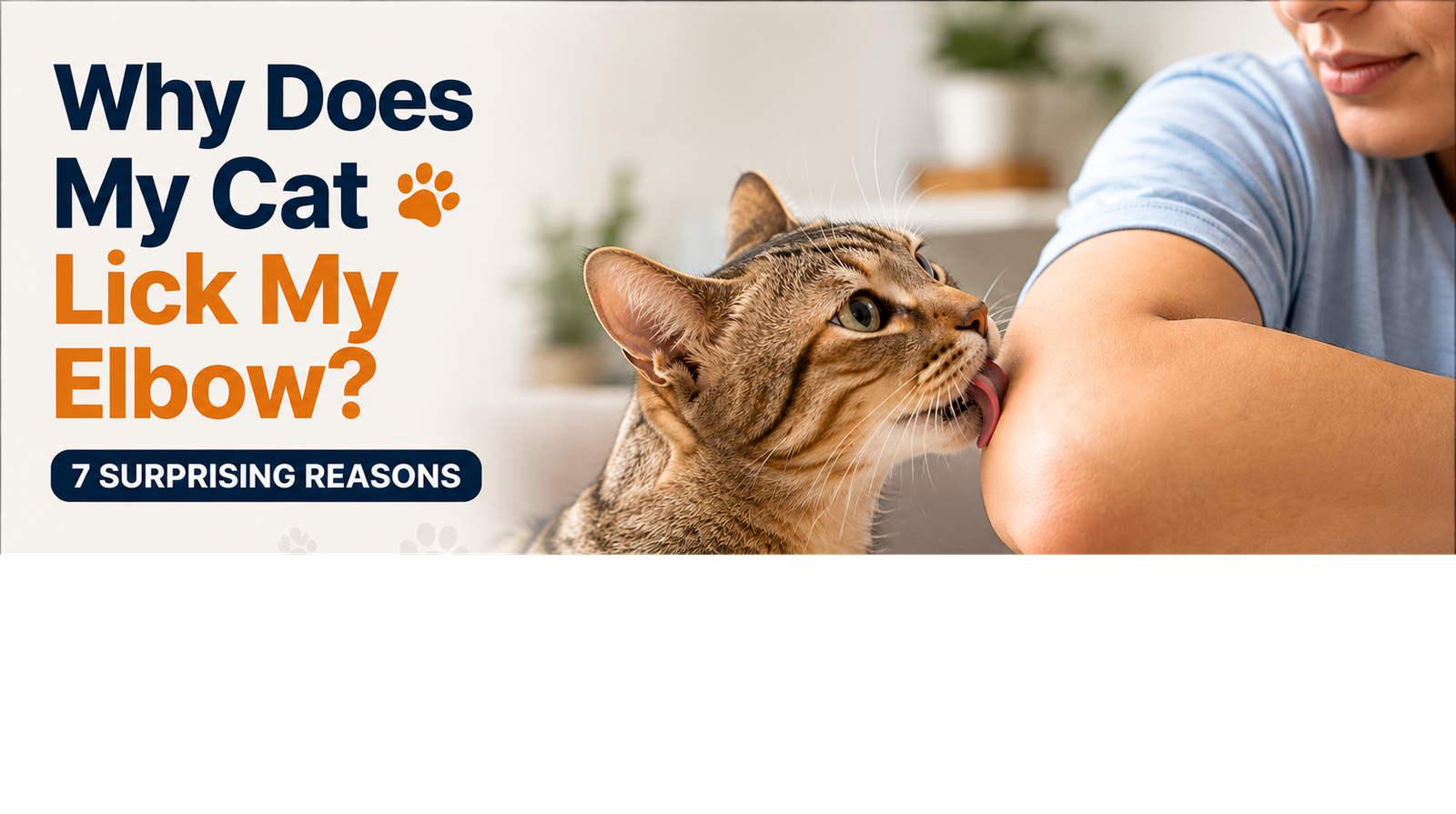
If you have ever wondered why does my cat lick my elbow, you are definitely not alone. Cats sometimes lick their owners in places that seem completely random, including elbows, arms, hands, ankles, and even feet.
In most cases, elbow licking is harmless and can be connected to affection, social grooming, curiosity, attention, your skin’s taste, or simple comfort. Cats use licking as a form of communication, so the reason can depend on what is happening around them.
The good news is that an occasional lick usually does not mean anything is wrong. However, if the behavior suddenly becomes excessive or comes with other changes, it is worth paying closer attention.
Quick Facts About Cat Licking
| Question | Answer |
| Why does my cat lick my elbow? | Affection, grooming, attention, scent, taste, curiosity, or comfort can all play a role. |
| Is elbow licking normal? | Occasional licking is generally normal feline behavior. |
| Does licking mean my cat loves me? | It can be a social or affectionate behavior, but licking has several possible meanings. |
| Why does my cat choose my elbow? | The elbow is usually easy to reach and carries your familiar scent and natural skin oils. |
| Can sweat attract my cat? | Yes. Salt and other compounds in perspiration can make skin interesting to some cats. |
| Should I let my cat lick me? | Occasional licking of clean, intact skin is generally not a major concern. |
| What about lotion? | Prevent licking of products that may be unsafe for cats. |
| When should I worry? | Sudden, excessive licking or licking combined with other health or behavior changes deserves attention. |
Why Does My Cat Lick My Elbow?
The simplest explanation is that licking is a normal part of feline social behavior.
Cats learn grooming behavior early in life. Mother cats groom their kittens, and cats that have friendly relationships may groom one another. This type of social grooming can help reinforce familiarity and bonds.
When a cat licks a person’s skin, it may be extending some of that familiar behavior toward a trusted human.
But affection is not the only possible reason. Veterinary sources identify several explanations for cats licking people, including social bonding, grooming, attention seeking, scent, taste, comfort, and stress.
That means your cat’s elbow obsession may have more than one explanation.
Here are seven of the most likely reasons.
1. Your Cat May Be Showing Affection
One of the most common explanations is affection.
Cats have their own ways of showing attachment. Some cats follow their owners from room to room, sleep beside them, rub against their legs, knead blankets, or gently head-butt them.
Others use licking.
If your cat approaches you calmly, settles beside you, purrs, and occasionally licks your elbow, the behavior may be part of a friendly interaction.
Your cat is not necessarily thinking about affection in exactly the same way a person does. Still, licking can be part of a positive social relationship.
Look at the entire interaction rather than the licking alone. A relaxed body, soft eyes, purring, rubbing, and comfortable proximity generally suggest that your cat feels safe around you.
2. Your Cat Could Be Grooming You
Cats are famously serious about grooming.
They regularly lick their own coats to remove loose material, maintain cleanliness, and perform other grooming functions. Cats may also groom other cats with which they have a social relationship.
So when your cat licks your elbow, it may be treating you like another member of its social group.
Of course, your elbow does not have fur that needs grooming. Your cat does not necessarily understand that distinction.
From the cat’s perspective, licking can simply be a familiar social behavior directed toward someone it trusts.
This is one reason the behavior can seem especially sweet when your cat follows a few licks by curling up next to you.
3. Your Skin Might Taste Interesting
Sometimes there is nothing mysterious happening at all.
Your skin has a natural taste. Perspiration can leave salts and other compounds on the surface, and some cats may find these interesting.
This can explain why your cat becomes more interested in your elbow after you have been outside, exercising, working, or simply feeling warm.
If the licking is brief and your cat loses interest after a few seconds, taste may be contributing to the behavior.
The same thing can happen with hands, arms, ankles, and other exposed areas.
This does not necessarily mean your cat is hungry. Cats investigate their environment with multiple senses, and taste can be part of that exploration.
4. Your Cat Likes Your Scent
Smell is extremely important to cats.
Your cat recognizes familiar people partly through scent, and your skin naturally carries your individual smell. Products such as soap, shampoo, deodorant, and moisturizers can add additional scents.
Your elbow may therefore be an interesting combination of familiar smells and skin oils.
Licking can occur alongside sniffing, rubbing, or head-butting. When several of these behaviors happen together, your cat may simply be interacting with a familiar person and reinforcing the scent association.
Cats also use scent-related behaviors as part of their social communication. Rubbing against people, for example, can be associated with familiarity and scent marking.
So if your cat licks your elbow and then rubs its face against you, that combination is worth noticing.
5. Licking May Get Your Attention
Cats quickly learn which behaviors make their owners respond.
Imagine your cat licks your elbow while you are sitting on the couch. You immediately look down, laugh, talk to the cat, and start petting it.
Your cat has just learned that licking can produce attention.
If this happens repeatedly, the behavior may become part of your cat’s routine.
This does not mean your cat is deliberately manipulating you. It simply means that behaviors followed by something rewarding can become more likely to happen again.
If you enjoy the interaction, there is usually no reason to make a problem out of occasional licking.
If you want it to stop, calmly moving your elbow away and redirecting your cat is generally more useful than scolding it.
6. It May Be a Comforting Behavior
Licking can also be connected with comfort.
Kittens experience grooming and close physical contact from their mother. Some cats retain oral behaviors into adulthood that can be associated with relaxation or self-soothing.
Veterinary behavior guidance notes that early-weaning history can sometimes be associated with persistent oral comfort behaviors such as licking or sucking.
However, you should not assume that your cat was weaned too early simply because it licks you.
Adult cats can lick people for many completely ordinary reasons.
If your cat mainly licks your elbow while relaxing, purring, kneading, or preparing to sleep, comfort may be one piece of the puzzle.
7. Stress or Anxiety Could Be Involved
Although occasional licking is normal, repetitive licking can sometimes be associated with stress.
Cats may develop repetitive behaviors when something in their environment makes them uncomfortable. Excessive self-grooming is more commonly discussed in veterinary settings, but unusual licking directed toward people can also occur.
Think about whether something recently changed.
Perhaps you moved furniture, introduced another pet, changed your schedule, moved homes, or your cat has been exposed to unusual noise.
A stressed cat may also hide more, become unusually vocal, change eating habits, groom excessively, or behave differently around people.
If elbow licking suddenly becomes much more frequent and is accompanied by other changes, do not automatically assume it is simply affection.
Why Does My Cat Lick My Elbow Specifically?
This is where the behavior gets interesting.
There probably is not a special feline meaning attached specifically to elbows. Your elbow is simply an accessible part of your body that happens to have your scent and natural skin oils.
Think about when your cat usually does it.
If you are sitting on the sofa with your arm exposed, your elbow may be directly in front of your cat. If you are lying in bed, it may be one of the easiest parts of your body to reach.
Your hands also move much more than your elbows. A moving hand can turn into a play opportunity, while a stationary elbow gives your cat a relatively stable target.
Your cat may also have learned that your elbow is a predictable place to get a reaction.
Once a behavior becomes part of a routine, cats can repeat it simply because the situation has become familiar.
What Your Cat’s Body Language Says
Licking becomes much easier to understand when you look at the rest of your cat’s body language.
Signs your cat is probably relaxed
- Purring
- Soft or partially closed eyes
- Relaxed ears
- Loose body posture
- Sitting or lying close to you
- Gentle rubbing
- Slow blinking
- Normal eating and playing
These behaviors generally fit comfortable social interaction.
Signs to pay closer attention to
- Sudden increase in licking
- Restlessness
- Hiding
- Excessive self-grooming
- Hair loss
- Red or irritated skin
- Appetite changes
- Unusual vocalization
- Aggressive or fearful behavior
A single unusual behavior is not enough to diagnose a problem. Changes in a cat’s overall behavior are more useful clues.
Is It Safe to Let Your Cat Lick Your Elbow?
For most healthy people, an occasional lick on clean, intact skin is generally not a major concern.
Still, there are situations where you should prevent it.
Do not allow your cat to lick open wounds, cuts, sores, or irritated skin. You should also prevent your cat from licking areas where you have applied products that could be harmful if swallowed.
This is particularly important with certain medications, creams, ointments, essential oils, and other topical products.
Some substances that are safe for people when used correctly can be dangerous for cats if they ingest them.
Veterinary guidance recommends being cautious about topical products and avoiding contact with broken skin.
If your cat wants to lick a treated area, gently move the area away and redirect the cat to something else.
How to Stop Your Cat From Licking Your Elbow
If you dislike the rough feeling of a cat’s tongue, you do not have to tolerate it.
The easiest approach is calm redirection.
When your cat starts licking, gently move your elbow away. You can then offer a toy, initiate a short play session, give your cat attention in another way, or simply change your position.
Avoid yelling or physically punishing your cat.
Punishment can create fear without teaching your cat what you would prefer it to do.
If attention is encouraging the behavior, keep your reaction neutral. Once your cat stops, you can reward appropriate interaction with petting or play.
Providing enough daily enrichment can also help. Scratching posts, climbing spaces, interactive toys, food puzzles, and regular play sessions give cats appropriate ways to explore and stay occupied.
What If My Cat Licks Me and Then Bites?
Some cats lick and then suddenly bite their owner.
That does not automatically mean the cat has become aggressive.
Cats can move between grooming, play, excitement, and overstimulation quickly. The important distinction is between gentle mouthing and an aggressive bite.
If the bite is accompanied by flattened ears, tense muscles, hissing, growling, swishing or rapidly moving tail, or an attempt to escape, give your cat some space.
If your cat becomes overstimulated during petting, stopping the interaction before it reaches that point can prevent bites.
Over time, you can learn your individual cat’s warning signals.
What Do Cat Owners Say About Elbow Licking?
This behavior is not limited to one household.
A Reddit user described a shy cat approaching and repeatedly licking their elbow. The discussion shows that other cat owners have also encountered this unusual behavior and naturally wondered whether it represented affection, grooming, or something else.
You can read the original Reddit discussion here:
Reddit: My cat just came up and licked my elbow
A similar question appears on Quora, where a cat owner asks whether licking an arm could be a form of grooming or a positive response to being petted:
Quora: Why does my cat lick my arm?
These discussions are useful because they show that the behavior occurs in real households, but individual comments should not be treated as veterinary evidence.
When Should You Call the Vet?
An occasional lick is usually not something that requires a veterinary visit.
The situation changes when licking becomes excessive, suddenly appears, or occurs alongside other concerning changes.
For example, excessive grooming or licking that results in hair loss, redness, sores, or damaged skin should be investigated. A noticeable change in eating, sleeping, playing, or normal behavior is also worth discussing with a veterinarian.
The same applies if your cat seems physically uncomfortable or unusually anxious.
The important point is not to panic because your cat licked your elbow.
Instead, compare the behavior with your cat’s normal routine.
If everything else is normal, occasional licking is usually just another quirky part of feline behavior.
How to Understand Your Cat’s Licking Habit
Rather than asking only what the licking means, consider when it happens.
Does your cat lick your elbow when you are relaxing together? Does it happen after you exercise? Does it occur when you are petting your cat? Does your cat lick once or continue for several minutes?
These details can provide useful clues.
For example, licking after exercise could point toward the interesting taste of perspiration. Licking during cuddling may fit social grooming or affection. Licking whenever you stop paying attention could suggest attention seeking.
There may also be more than one reason.
Your cat could enjoy your scent, like the taste of your skin, and simultaneously enjoy the social interaction.
Final Answer: Why Does My Cat Lick My Elbow?
So, why does my cat lick my elbow?
Most of the time, it comes down to normal feline behavior. Your cat may be grooming you, showing affection, seeking attention, investigating your scent, enjoying the taste of your skin, or using licking as a comforting activity.
The elbow itself probably is not special. It is simply an exposed, easy-to-reach area that smells like you.
Pay attention to the bigger picture. A relaxed cat that occasionally licks your elbow and otherwise eats, sleeps, plays, and behaves normally is usually not giving you a reason to worry.
If the licking becomes excessive, suddenly changes, damages the skin, or appears alongside other unusual behavior, a veterinarian can help determine whether there is an underlying medical or behavioral issue.
In other words, that strange little elbow lick may simply be your cat’s quirky way of interacting with someone it knows and trusts.
FAQs
Why does my cat lick my elbow?
Your cat may lick your elbow because of affection, social grooming, attention, curiosity, scent, the salty taste of skin, or comfort. More than one reason can apply at the same time.
Does my cat licking my elbow mean it loves me?
It can be part of an affectionate relationship. If your cat is relaxed, purring, rubbing against you, and choosing to stay close, the licking may be part of friendly social interaction.
Why does my cat lick my skin?
Cats may find the taste, scent, oils, or salt on human skin interesting. They may also lick people as a form of social grooming or to gain attention.
Why does my cat lick my elbow at night?
Your cat may simply be following a familiar nighttime routine. If you are lying still, your elbow may also be easy for your cat to reach.
Can sweat make my cat lick me?
Yes. Perspiration leaves salts and other compounds on the skin, which may make certain areas interesting to a cat.
Should I let my cat lick my elbow?
If your skin is clean and intact and there are no potentially harmful products on it, occasional licking is generally not a major concern. Avoid letting cats lick wounds or topical products.
Why does my cat lick me and then bite me?
Licking followed by biting can happen during grooming, play, or overstimulation. Watch your cat’s body language to determine whether the bite is gentle mouthing or a sign that the cat wants the interaction to stop.
How do I stop my cat from licking my elbow?
Calmly move your elbow away and redirect your cat toward a toy, play session, grooming, or another activity. Avoid punishment.
Is licking a sign that my cat is stressed?
Sometimes repetitive licking can be associated with stress, but there can also be medical or behavioral explanations. A sudden increase accompanied by other changes deserves attention.
When should I worry about my cat licking me?
Talk with a veterinarian if the behavior becomes excessive or is accompanied by hair loss, skin irritation, appetite changes, hiding, unusual behavior, or other signs that your cat is not feeling well.
Must read our other blogs:
Best Pet Supplies Voyager Step-In Air Dog Harness: Why It’s a Top Choice for Comfortable Walks