If you’re wondering is Tiki Cat food good, the short answer is yes, many Tiki Cat recipes are a strong choice, especially the wet foods. They generally emphasize animal-based protein, high moisture, and relatively low carbohydrate levels, although not every Tiki Cat recipe has the same nutritional profile.
The biggest distinction is between Tiki Cat wet food and dry food. Wet recipes tend to fit a carnivore-focused diet more closely, while the dry formulas still contain substantially more carbohydrates because kibble needs starches or similar ingredients to hold its shape.
So, is Tiki Cat worth buying? For many cats, yes—but the individual recipe matters more than the brand name alone.
Is Tiki Cat Food Good? Quick Facts
| Feature | Tiki Cat |
| Overall quality | Generally high |
| Best option | Many wet food recipes |
| Protein | Generally high |
| Moisture | High in wet formulas |
| Carbohydrates | Low in many wet recipes |
| Dry food | Better than many kibbles, but higher in carbs |
| Main proteins | Chicken, tuna, fish and other animal ingredients |
| Grain-free options | Yes |
| Manufacturing | Wet foods are made in Thailand |
| Recall history | Cats.com reports no recalls |
| Price | Premium |
| Best for | Cats that do well on high-protein, moisture-rich food |
One important point: Tiki Cat is a brand with many different formulas, not one single recipe. Nutritional values and ingredients can vary considerably between lines and products.
AAFCO explains that owners should check the nutritional adequacy statement on the individual package because that tells you whether a food is complete and balanced for a particular life stage.
What Is Tiki Cat?
Tiki Cat is a premium cat food brand that was founded in 2005 by Christine and Robert Hackett. The brand built its reputation around recipes that place a strong emphasis on meat and fish rather than carbohydrate-heavy formulations.
The brand was originally part of Petropics and later became part of Whitebridge Pet Brands. In December 2024, General Mills completed its acquisition of Whitebridge Pet Brands’ North American premium cat feeding and pet treating business in a transaction valued at $1.45 billion. The deal included the Tiki Pets portfolio.
That ownership change is worth knowing, but it does not automatically mean the food became better or worse. The more useful question is whether the specific food you’re buying still provides an appropriate nutritional profile.
Tiki Cat currently offers wet foods, dry foods, kitten recipes, senior formulas, mousse products, and specialized Solutions products.
Why Is Tiki Cat Wet Food Considered Good?
The strongest part of the Tiki Cat lineup is its wet food.
Many Tiki Cat wet recipes use ingredients such as chicken, tuna, chicken broth, chicken liver, chicken gizzard, and chicken heart. These ingredients provide animal-based protein and help create recipes that are relatively close to the type of food many cat owners want for an obligate carnivore.
Moisture is another major advantage.
Cats naturally have a relatively low thirst drive, so getting water through food can be useful. Wet food supplies considerably more moisture than dry kibble, which is one reason many owners prefer feeding at least some canned or pouch food.
For example, Cats.com’s analysis of Tiki Cat Puka Puka Luau reported 16% crude protein and 80% moisture on the label’s guaranteed analysis. On a dry-matter basis, the reviewer calculated approximately 80% protein.
That’s an impressive protein profile for a wet cat food.
Tiki Cat Ingredients: Are They High Quality?
In general, many Tiki Cat recipes have simple ingredient lists built around recognizable animal ingredients.
A recipe such as Tiki Cat Puka Puka Luau Succulent Chicken in Chicken Consommé starts with chicken and chicken broth. Another After Dark recipe reviewed by Pet Food Reviews Australia includes chicken broth, chicken, chicken liver, chicken gizzard, chicken heart, and dried egg product near the beginning of the ingredient list.
This is a positive feature because ingredients are listed by weight before processing, and AAFCO notes that ingredients appear in order of predominance on the label.
However, Tiki Cat isn’t completely free from ingredients that some owners may question.
Sunflower oil appears in several recipes. Cats.com specifically criticized its use as a plant-based fat source in some formulas, preferring animal-derived fats or fish oils.
Some recipes also contain gums or other functional ingredients used to create texture. These ingredients aren’t automatically harmful simply because their names sound unfamiliar, but cats with specific digestive sensitivities may respond differently.
Is Tiki Cat Low in Carbohydrates?
Many Tiki Cat wet foods are very low in carbohydrates, which is one of their biggest advantages.
Cats do not have a dietary requirement for carbohydrates in the same way they require certain essential amino acids and other nutrients. A moisture-rich, protein-focused wet diet can therefore be appealing to owners trying to reduce unnecessary starch.
Cats.com’s analysis found the carbohydrate content of some Tiki Cat wet foods to be extremely low, including one chicken recipe that the reviewer calculated at zero carbohydrates.
But don’t assume every Tiki Cat product is carbohydrate-free.
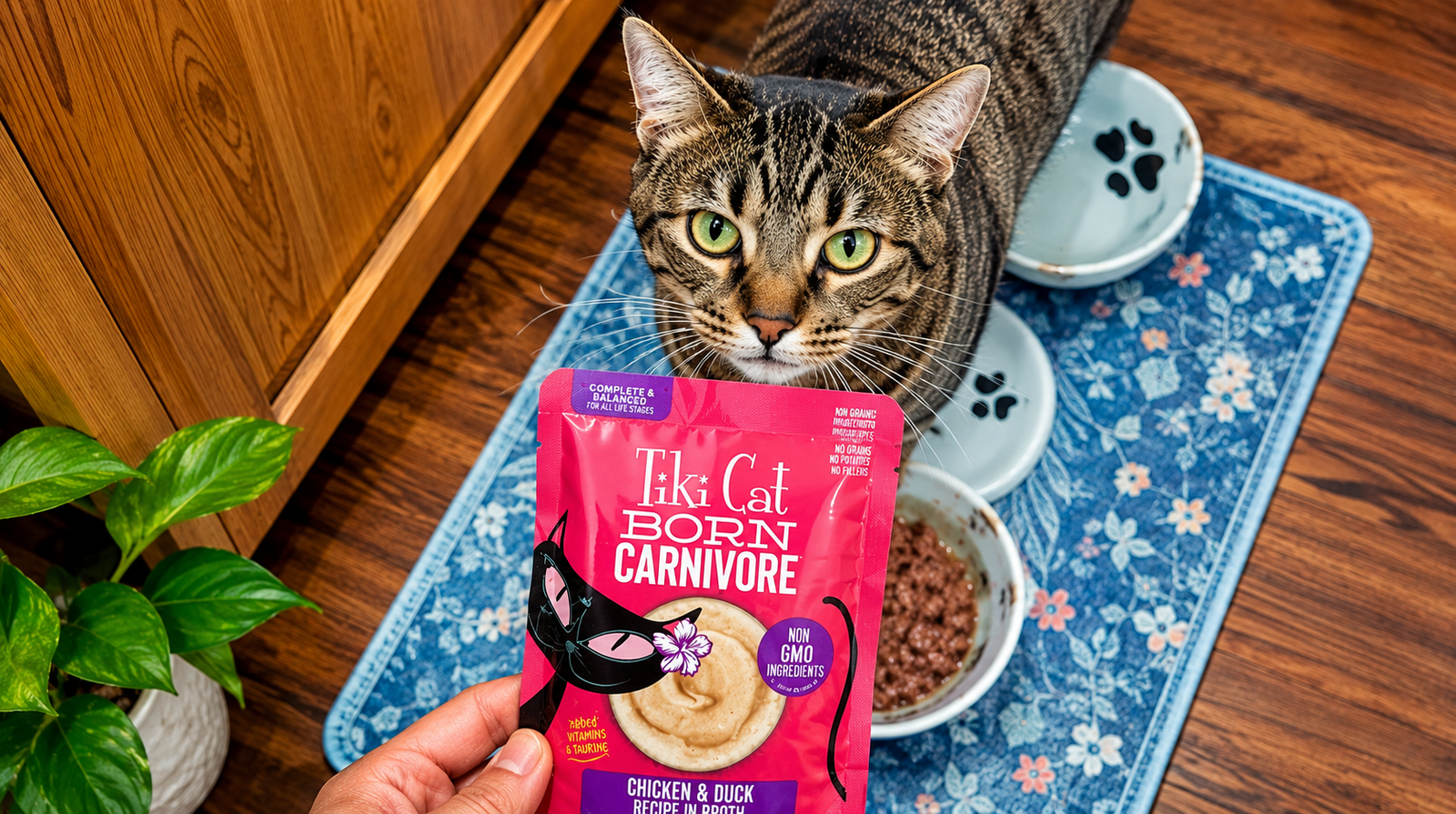
The dry foods are different. Tiki Cat Born Carnivore Chicken & Egg, for example, contains tapioca, chickpeas, peas, and other plant ingredients. Cats.com calculated approximately 15.63% carbohydrates on a dry-matter basis for the particular recipe it reviewed.
That’s why comparing the exact recipe is more useful than simply asking whether Tiki Cat is low-carb.
Is Tiki Cat Dry Food Good?
Tiki Cat dry food is reasonably strong compared with many conventional kibbles, but its wet food generally has the nutritional advantage.
One Tiki Cat Born Carnivore Chicken & Egg recipe reviewed by Cats.com contained 43% crude protein, 19% crude fat, and 10% moisture on its guaranteed analysis. Its first ingredients included deboned chicken, chicken meal, dehydrated chicken, and dried egg product.
That’s a protein-rich formula for kibble.
The drawback is that dry food requires starch or another structural ingredient to create kibble. In this recipe, tapioca appears fifth, followed by ingredients including chickpeas and peas.
Pet Food Reviews Australia reached a similar conclusion: it considered Tiki Cat dry food better formulated than many alternatives while still noting that ingredients such as tapioca, peas, and chickpeas aren’t particularly necessary for cats.
So if your cat loves kibble, Tiki Cat can be a reasonable option. If your goal is maximum moisture and minimal carbohydrate, Tiki Cat wet food is usually the more attractive choice.
Is Tiki Cat Good for Picky Cats?
It can be.
Tiki Cat offers different textures, including shredded foods, pâtés, mousses, and other preparations. Its current lineup includes options such as After Dark, Luau, Velvet Mousse, Grill, Friends, Baby, and Silver.
That’s helpful because cats can be extremely particular about texture and smell.
Cats.com’s testing found that the reviewers’ cats generally responded well to several Tiki Cat recipes, although customer reviews also show that individual cats can reject particular flavors or textures.
If your cat is picky, don’t buy a large quantity of one flavor immediately. Try a small variety first and see whether your cat prefers shredded chicken, fish, pâté, or mousse.
Is Tiki Cat Good for Cats With Diabetes?
Some low-carbohydrate Tiki Cat wet foods may be useful for cats whose diet needs to remain low in carbohydrates, but a veterinarian should guide nutrition for a cat with diabetes.
Cats.com specifically highlights some Tiki Cat wet foods as potentially suitable for cats with diabetes because of their high protein and very low carbohydrate profiles.
However, changing food can alter calorie intake and, in diabetic cats receiving insulin, glucose control. A food that looks excellent on paper isn’t automatically the correct therapeutic diet for every individual cat.
For a healthy cat, choosing a complete and balanced wet food is usually a straightforward nutritional decision. For a cat with a diagnosed medical condition, ask your veterinarian before making a major diet change.
Tiki Cat After Dark: Is It Worth Trying?
Tiki Cat After Dark is one of the more interesting lines for owners who want animal-based ingredients.
Recipes in this range can include muscle meat and organ ingredients such as chicken liver, gizzard, and heart. Organ meats naturally contribute nutrients that are important in a carnivore-appropriate diet.
The main thing to remember is that “more meat” doesn’t automatically make a food complete and balanced. The nutritional adequacy statement on the package still matters.
If the product is labeled as complete and balanced for your cat’s life stage, that’s much more meaningful than relying on marketing terms such as “carnivore” or “natural.”
For more guidance on evaluating cat food labels, see the AAFCO guide to reading pet food labels.
Has Tiki Cat Ever Been Recalled?
Cats.com’s current review reports that Tiki Cat has not had a recall and gives the brand 10/10 for recall history.
That is a positive point, but a recall-free history should not be treated as proof that every recipe is perfect.
There have also been customer reports over the years about unusual gray coloration in some canned Tiki Cat products. Cats.com reported that the company attributed the discoloration to normal cooking effects and noted that its review of customer feedback did not show evidence that cats became sick from the affected-looking food.
If a can is swollen, leaking, damaged, smells abnormal, or looks clearly spoiled, don’t feed it. Contact the retailer or manufacturer instead.
What Are the Downsides of Tiki Cat?
Tiki Cat has several advantages, but it isn’t perfect.
First, it’s expensive. Cats.com’s analysis estimated that feeding certain Tiki Cat wet recipes to a 10-pound cat could cost roughly $2.96 to $5 per day depending on the recipe.
Second, not every formula is equally strong. The wet recipes can be extremely low in carbohydrates, while dry formulas necessarily contain more starch-like ingredients.
Third, some recipes use plant-based ingredients or oils that certain nutrition-focused owners may prefer to avoid.
Fourth, calories can be relatively low in some wet foods. This means a cat may need more food by volume to meet daily energy needs than it would with a calorie-dense formula.
Finally, cats have individual preferences. Even a highly rated food isn’t useful if your cat refuses to eat it.
Tiki Cat vs Other Cat Food: Is It Worth the Price?
| Category | Tiki Cat |
| Animal protein | Excellent in many wet recipes |
| Moisture | Excellent in wet food |
| Carbohydrate control | Excellent in many wet recipes |
| Ingredient transparency | Generally good |
| Recipe variety | Good |
| Dry food | Good, but less ideal than wet |
| Price | Higher than budget brands |
| Picky-cat appeal | Often good, but individual |
| Overall value | Strong if your cat eats it consistently |
Cats.com’s overall assessment gave the brand 8.5/10, while Pet Food Reviews Australia gave its reviewed range 8.9/10. Those ratings aren’t official nutritional certifications, but they support the broader conclusion that Tiki Cat is generally viewed favorably by independent reviewers.
Final Verdict: Is Tiki Cat Food Good?
Yes, Tiki Cat is generally a good cat food, with its wet formulas standing out as the strongest part of the range.
The combination of animal-based protein, high moisture, and low carbohydrate levels makes many Tiki Cat wet foods attractive for healthy adult cats. The ingredient lists are also generally meat-focused, particularly in recipes that feature chicken, fish, and organ meats.
The dry food is a little more complicated. It can provide high protein compared with many kibbles, but it still contains carbohydrate-containing ingredients and doesn’t provide the same moisture advantage as canned food.
The best approach is therefore simple: choose the individual Tiki Cat recipe based on its nutritional adequacy statement, ingredients, calories, moisture, and your cat’s specific needs—not just the Tiki Cat name on the package.
For a healthy cat that enjoys wet food, Tiki Cat is certainly a brand worth considering.
FAQs
1. Is Tiki Cat food actually good for cats?
Yes. Many Tiki Cat recipes are high in animal-based protein, high in moisture, and relatively low in carbohydrates, particularly the wet foods.
2. Is Tiki Cat wet food better than Tiki Cat dry food?
For many cats, wet food has an advantage because it provides much more moisture and many Tiki Cat wet recipes are very low in carbohydrates. Tiki Cat dry food can still be a reasonable kibble choice, but it does not offer the same moisture profile.
3. Is Tiki Cat good for picky cats?
It can be. Tiki Cat offers several textures and flavors, and independent testing has found good acceptance among some cats. However, individual preferences vary widely.
4. Is Tiki Cat high in protein?
Many Tiki Cat foods are high in protein. For example, Cats.com’s reviewed Puka Puka Luau recipe lists 16% crude protein and 80% moisture, which works out to about 80% protein on a dry-matter basis.
5. Is Tiki Cat grain-free?
Many Tiki Cat recipes are grain-free, but you should check the exact ingredient list rather than assuming every product has the same formula.
6. Is Tiki Cat good for diabetic cats?
Some low-carbohydrate Tiki Cat wet recipes may fit a diabetic cat’s nutritional needs, but diabetic cats should have diet changes discussed with their veterinarian because food changes can affect glucose management.
7. Has Tiki Cat ever been recalled?
Cats.com’s current review reports that Tiki Cat has no recall history.
8. Is Tiki Cat worth the money?
For owners who prioritize high-protein, moisture-rich food, Tiki Cat can justify its premium price. The main drawback is cost, particularly when feeding wet food every day.
9. Is Tiki Cat made in the USA?
Tiki Cat’s wet foods are made in Thailand. Cats.com reports that the brand uses Thai manufacturing facilities for its wet foods.
10. Who owns Tiki Cat in 2026?
Tiki Cat is part of the Tiki Pets portfolio owned by General Mills. General Mills completed its acquisition of Whitebridge Pet Brands’ North American premium cat feeding and treating business in December 2024.
Must read our other blogs:
Wet Pet Food: Complete Guide to Healthy, Nutritious Meals