If you’re asking is Orijen cat food good, the short answer is yes, it can be a good choice for many healthy cats, but it is not the perfect food for every cat. Orijen is known for high-protein recipes built around animal ingredients, but its dry formulas are also calorie-dense and contain legumes that some cats may not tolerate well.
The brand has a strong reputation among cat owners who want premium, meat-focused food. At the same time, independent reviews and owner experiences show that Orijen has both loyal supporters and critics. That makes it worth looking beyond the marketing and examining the actual food, ingredients, nutrition, and potential drawbacks.
Is Orijen Cat Food Good? Quick Facts
| Feature | Orijen Original Cat |
| Food type | Dry cat food |
| Life stage | All life stages |
| Protein | 40% minimum |
| Fat | 20% minimum |
| Fiber | 3% maximum |
| Moisture | 10% maximum |
| Calories | 515 kcal per 8-oz cup |
| Main animal ingredients | Chicken, turkey, herring, turkey giblets, salmon |
| Taurine | 0.2% minimum |
| Grain-free | Yes |
| Main strength | High protein and substantial animal ingredients |
| Main concern | Low moisture, calorie density, and multiple legumes |
Orijen’s current Original Cat formula lists 40% minimum crude protein and 20% minimum crude fat. It provides 515 calories per 8-ounce cup and is formulated to meet AAFCO Cat Food Nutrient Profiles for all life stages.
Those numbers make it a nutrient-dense food. However, the quality of a cat’s diet cannot be determined from protein percentage alone.
What Is Orijen Cat Food?
Orijen is a premium pet-food brand originally developed by Champion Petfoods. Mars Petcare completed its acquisition of Champion Petfoods in 2024, bringing Orijen and Acana into its portfolio.
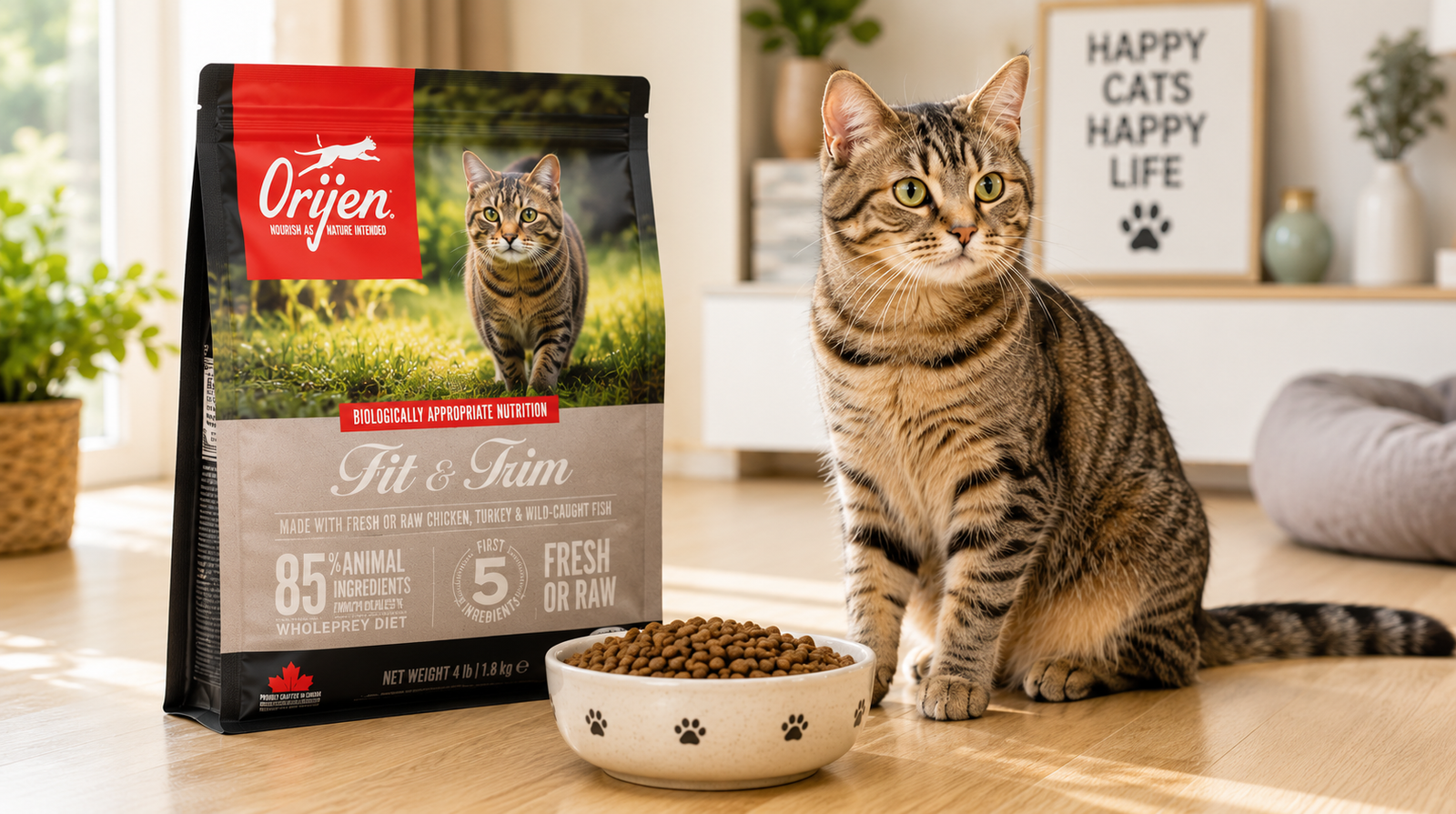
The brand’s philosophy centers on recipes containing substantial amounts of animal ingredients. Orijen also uses its WholePrey concept, which incorporates ingredients such as meat, organs, and other animal components.
The current Original Cat recipe begins with chicken, turkey, whole herring, turkey giblets, and salmon. It also contains dehydrated poultry and fish ingredients, eggs, animal organs, and chicken fat.
This gives Orijen a very different ingredient profile from inexpensive dry foods that rely more heavily on plant-based ingredients.
However, there is an important point to remember: Orijen is still dry kibble. A premium ingredient list doesn’t change the fact that kibble contains considerably less water than canned food.
Orijen Cat Food Ingredients: What Makes Them Different?
The ingredient list is one of Orijen’s biggest strengths.
Animal ingredients appear prominently at the beginning of the Original Cat recipe. Chicken, turkey, herring, turkey giblets, salmon, dehydrated chicken, dehydrated turkey, and dehydrated salmon all contribute to the recipe’s protein content.
The inclusion of organs is another positive feature. Liver, heart, and gizzard can naturally provide a range of nutrients, making them useful components of a complete feline diet.
The formula also includes eggs and fish ingredients. These contribute additional animal-derived nutrients and fatty acids.
Orijen’s approach is therefore more than simply adding one meat ingredient to an otherwise plant-heavy kibble. It uses a broad range of animal ingredients throughout the recipe.
That said, a long ingredient list should not automatically be interpreted as proof that a food is superior. The finished product’s nutritional adequacy, digestibility, calorie density, and suitability for the individual cat matter more.
Is Orijen Cat Food High in Protein?
Yes. Orijen Original Cat contains a minimum of 40% crude protein on an as-fed basis.
That’s considerably higher than many conventional dry cat foods and is one of the main reasons owners choose Orijen.
Cats need dietary protein, and animal-derived protein is particularly important because cats have nutritional requirements shaped by their carnivorous biology.
But high protein doesn’t mean that every high-protein food is automatically better.
A cat’s overall diet also needs appropriate levels of fat, essential amino acids, vitamins, minerals, and other nutrients. The food must also be suitable for the cat’s age, health, and energy requirements.
In other words, Orijen’s 40% protein figure is a positive feature, but it shouldn’t be the only number you consider.
Is Orijen Cat Food Grain-Free?
Yes. The current Original Cat recipe is grain-free and does not list corn, wheat, or soy among its ingredients.
Instead, the formula uses ingredients such as lentils, peas, chickpeas, and several types of beans.
Grain-free diets have become popular among pet owners, but grain-free does not automatically mean healthier.
Healthy cats do not need a food to be grain-free simply because they are cats. What matters is whether the complete diet supplies appropriate nutrition and whether the individual cat tolerates it.
This is an important distinction because “grain-free” is a marketing characteristic, not a guarantee of better health.
Does Orijen Contain Too Many Legumes?
This is one of the most reasonable criticisms of the formula.
The Original Cat ingredient list contains red lentils, pinto beans, green lentils, navy beans, chickpeas, peas, and lentil fiber.
These ingredients aren’t automatically harmful. They can contribute carbohydrate, fiber, and plant-derived nutrients to the recipe.
The concern is more about how much of the overall formula comes from plant ingredients and whether an individual cat tolerates them.
Some cat owners report excellent digestion on Orijen, while others report loose stools, vomiting, or other digestive problems. Online owner discussions also include claims about urinary issues, but those personal reports do not establish that Orijen caused those medical problems.
This is where anecdotal evidence needs to be handled carefully.
A cat developing crystals or a urinary problem after eating a particular food does not, by itself, prove that the food caused the condition. Many factors can contribute to urinary disease, including hydration, individual health, environment, and previous medical history.
Is Orijen Good for Cats With Sensitive Stomachs?
Not necessarily.
Some cats with sensitive digestion may do very well on Orijen, while others may struggle with it.
One reason is the large number of protein sources used in the recipe. Original Cat includes poultry, several fish ingredients, eggs, and animal organs.
For a healthy cat that handles different proteins well, this variety isn’t necessarily a problem.
For a cat with a suspected food intolerance, however, a food containing many different ingredients can make it harder to determine which ingredient is causing a reaction.
This is one area where Orijen isn’t designed as a classic limited-ingredient diet.
If your cat has recurring vomiting, diarrhea, weight loss, or another persistent digestive issue, it is better to speak with a veterinarian rather than assuming that switching to a premium food will solve the problem.
Is Orijen Good for Kittens?
Yes, Orijen Original Cat is formulated for all life stages, which includes growth.
That makes it a potential option for kittens when it is fed according to appropriate feeding recommendations.
The major issue is portion control.
Original Cat provides approximately 515 calories per 8-ounce cup, making it relatively energy-dense. Growing kittens need plenty of calories, but their intake still needs to be monitored as they develop.
Kittens should not simply be allowed unlimited access to a calorie-dense kibble without considering their growth, body condition, and activity level.
If you’re feeding a kitten, monitor weight and development regularly and follow the feeding recommendations for the specific product.
The Biggest Weakness: Orijen Is Dry Food
When discussing is Orijen cat food good, one major factor should not be overlooked: moisture.
The current Original Cat formula lists a maximum moisture level of 10%.
That’s normal for dry kibble, but it is far below the moisture content found in most canned cat foods.
Cats can obtain water from drinking, but many cats are not enthusiastic drinkers. This makes dietary moisture an important consideration when choosing between dry and wet food.
This does not mean Orijen dry food is inherently bad.
It simply means that an owner should think about the cat’s total water intake rather than focusing only on the protein percentage.
Some owners choose to feed a combination of dry and wet food to increase dietary moisture while retaining the convenience of kibble.
Is Orijen Cat Food Good for Weight Control?
It depends on the cat and the portion size.
Orijen Original Cat contains about 515 calories per 8-ounce cup, so it is a calorie-dense food.
That can be useful for cats with higher energy needs, but it can also make overfeeding easier.
This matters particularly for indoor cats, older cats, and cats that are naturally less active.
A bowl that looks like a small amount of kibble can still contain a significant number of calories.
For that reason, measuring portions is much better than filling the bowl whenever it looks empty.
Body condition is also more useful than simply following a fixed amount forever. A cat’s calorie needs can change with age, activity, neutering status, and health.
What Do Independent Reviews Say About Orijen?
Orijen receives mixed-to-positive attention from independent pet-food reviewers. The strongest points are its high animal-protein content, substantial use of animal ingredients, and relatively detailed ingredient profile. However, its high calorie density, dry-food format, price, and use of multiple legumes are worth considering before making it your cat’s main diet.
For a detailed independent breakdown of the formula, ingredients, nutrition, and potential drawbacks, see the Orijen Cat Food Review from Cats.com.
Overall, the evidence suggests that Orijen can be a good choice for many healthy cats, but it is not automatically the best food for every cat. Individual tolerance, hydration needs, age, activity level, and any existing health concerns should all be considered when choosing a diet.
What Are Cat Owners Saying About Orijen?
Owner feedback is mixed.
Some Reddit users report that their cats have eaten Orijen for years without obvious problems. Others describe digestive upset, vomiting, loose stools, weight issues, or concerns about urinary health after feeding it.
There are also owners who report that their cats do particularly well when Orijen is only part of the diet and wet food makes up another portion.
These experiences are worth paying attention to, but they should remain in the category of anecdotal reports.
For example, several owners in the discussion attribute urinary crystals or UTIs to Orijen. Those are personal accounts and do not prove a causal relationship between the food and the medical condition.
The same applies to positive experiences. A cat thriving on Orijen doesn’t prove that Orijen is objectively superior to every other complete cat food.
The most reasonable conclusion is that cats respond differently.
Orijen Cat Food Pros and Cons
Pros
- High minimum protein level
- Strong emphasis on animal ingredients
- Multiple animal protein sources
- Includes organ meats
- Contains taurine
- Contains fish-derived omega-3 fatty acids
- Grain-free
- No corn, wheat, or soy in the current Original Cat recipe
- Formulated for all life stages
- Multiple formulas are available for different needs
Cons
- Expensive compared with many standard dry foods
- Very calorie-dense
- Low moisture compared with wet food
- Contains several legumes
- Uses many different protein sources
- May not suit every cat with digestive sensitivities
- Grain-free does not automatically mean nutritionally superior
- Owner experiences are mixed
The balance is fairly clear: Orijen’s strongest argument is its animal-focused, high-protein formulation; its biggest limitations are its dry format, calorie density, price, and individual tolerance.
Is Orijen Better Than Regular Cat Food?
There is no simple yes-or-no answer.
If you’re comparing Orijen with a low-quality food that doesn’t meet your cat’s nutritional needs, Orijen may offer a stronger formulation.
But comparing two complete and balanced foods requires more than looking at which ingredient list sounds better.
You should consider:
- Nutritional adequacy
- Protein and fat levels
- Calories
- Moisture
- Feeding amount
- Ingredient tolerance
- Your cat’s age
- Activity level
- Body condition
- Any diagnosed medical conditions
A food that looks excellent on paper isn’t automatically better if your cat refuses to eat it or develops digestive problems.
Likewise, a food doesn’t become poor quality simply because it isn’t marketed as “premium.”
How to Introduce Orijen to Your Cat
If you decide to try Orijen, transition gradually rather than making an abrupt switch.
Start with a small amount of the new food mixed with the current diet. Increase the Orijen portion over several days while reducing the old food.
A gradual transition can make digestive adjustment easier and also gives you a chance to notice whether your cat tolerates the food.
Watch for:
- Vomiting
- Diarrhea
- Constipation
- Changes in appetite
- Excessive weight gain
- Weight loss
- Changes in drinking or urination
- Changes in energy or behavior
If significant symptoms appear or persist, contact your veterinarian.
It is also a good idea to change only one major part of the diet at a time. If you introduce new dry food and new wet food simultaneously, it becomes harder to identify which change caused a problem.
Who Should Consider Orijen Cat Food?
Orijen may be worth considering if your cat is healthy and:
- Enjoys dry food
- Does well with multiple protein sources
- Needs a high-protein diet
- Maintains a healthy body weight
- Has no veterinary-directed dietary restriction
- Has reliable access to fresh water
- Does well with the specific formula
It may not be the best choice if your cat:
- Has a known food intolerance
- Needs a limited-ingredient diet
- Has a medical condition requiring therapeutic nutrition
- Is prone to excessive weight gain
- Doesn’t tolerate legumes or multiple proteins
- Has difficulty maintaining adequate hydration
For cats with diagnosed kidney, urinary, gastrointestinal, or other medical conditions, dietary choices should be discussed with a veterinarian.
Final Verdict: Is Orijen Cat Food Good?
Yes, Orijen cat food can be a good choice for many healthy cats, but it should not be treated as a universally superior diet.
The current Original Cat recipe has several genuine strengths: a minimum of 40% crude protein, substantial animal ingredients, organ meats, fish, taurine, and formulation for all life stages.
The weaknesses are just as worth knowing. It is dry food with relatively little moisture, it is calorie-dense, it contains multiple legumes and protein sources, and it costs more than many mainstream alternatives.
The available reviews also show why a balanced opinion is more useful than a simple five-star rating. Some reviewers are extremely positive, while independent evaluations and owner discussions point to limitations and mixed experiences.
Our verdict: Orijen is a high-quality option to consider, especially for healthy cats that thrive on high-protein dry food, but your cat’s individual response should ultimately determine whether it is the right choice.
If your cat eats it willingly, maintains a healthy weight, has normal digestion, stays properly hydrated, and shows no health problems, there is a reasonable case for continuing it.
If your cat develops persistent digestive or urinary symptoms, don’t assume that the food must be responsible—but don’t ignore the symptoms either. A veterinarian can help determine whether the diet, hydration, an underlying condition, or another factor needs attention.
FAQs About Orijen Cat Food
1. Is Orijen cat food actually good?
Yes. Orijen offers high-protein recipes with substantial animal ingredients and can be a good option for many healthy cats. However, individual tolerance and health needs matter.
2. Is Orijen cat food high in protein?
Yes. Orijen Original Cat contains a minimum of 40% crude protein on an as-fed basis.
3. Is Orijen good for kittens?
Yes. Orijen Original Cat is formulated for all life stages, including growth. Portions should still be adjusted according to the kitten’s age, growth, and energy needs.
4. Is Orijen cat food grain-free?
Yes. The current Original Cat formula is grain-free and does not list corn, wheat, or soy.
5. Does Orijen contain peas and lentils?
Yes. The recipe contains several legumes, including red lentils, green lentils, peas, chickpeas, pinto beans, and navy beans.
6. Is Orijen good for cats with sensitive stomachs?
It can work for some cats, but it isn’t a limited-ingredient formula. Because it contains numerous animal proteins and legumes, some sensitive cats may do better with a simpler diet.
7. Can cats eat Orijen every day?
Yes, an appropriate complete and balanced Orijen formula can be fed regularly when it suits the cat. Portion control and hydration are particularly important with the dry formulas.
8. Does Orijen cat food contain taurine?
Yes. Orijen Original Cat’s guaranteed analysis lists a minimum taurine level of 0.2%.
9. Can Orijen cause urinary problems?
There is no basis here to say that Orijen universally causes urinary disease. Some individual owners report urinary problems after feeding it, but those anecdotes do not prove that the food caused the condition. Cats with urinary symptoms should be evaluated by a veterinarian.
10. Is Orijen better than wet cat food?
Not necessarily. Orijen’s dry food offers high protein and convenience, while wet food generally provides much more moisture. The better choice depends on the individual cat and the overall diet.
Must read our other blogs:
Is Tiki Cat Food Good? Honest 2026 Review & Guide