Going on vacation does not mean your cat has to feel forgotten or unsettled. Vacation Cat Care: Essential Tips for Keeping Your Cat Safe and Happy While You Travel is mainly about choosing the right care arrangement, maintaining familiar routines, preparing the home or travel setup, and making sure someone can respond quickly if something goes wrong.
For many cats, staying in their own home with a reliable caregiver can be less disruptive than traveling. Other cats may do better with boarding or, when appropriate, traveling with their owners. The best approach to Vacation Cat Care: Essential Tips for Keeping Your Cat Safe and Happy While You Travel depends on your cat’s personality, health, routine, and how long you will be away.
The most important thing is to make the plan before your suitcase comes out. A little preparation can prevent feeding mistakes, litter problems, escape attempts, and unnecessary stress.
Vacation Cat Care: Essential Tips for Keeping Your Cat Safe and Happy While You Travel — Quick Facts
| Care Question | Practical Answer |
| Best option for many cats | Staying home with a dependable sitter |
| Should cats be left completely alone? | No, extended unattended periods are not recommended |
| What should remain consistent? | Food, litter, medication, play, and daily routine |
| Should you take your cat traveling? | Only when travel is appropriate for that individual cat |
| Essential emergency preparation | Vet information, backup caregiver, and current ID |
| Important travel item | A secure, properly sized carrier |
Veterinary guidance cited by Dr. Elsey’s recommends having someone check on a cat at least once or twice a day while the owner is away, while PetMD also advises against leaving cats unattended for extended periods. Good Vacation Cat Care: Essential Tips for Keeping Your Cat Safe and Happy While You Travel should always include regular human supervision.
1. Decide Where Your Cat Should Stay
The first decision in Vacation Cat Care: Essential Tips for Keeping Your Cat Safe and Happy While You Travel is whether your cat should stay home, stay with a sitter elsewhere, go to a boarding facility, or travel with you.
For many cats, home care is the least disruptive option. Cats are strongly attached to familiar surroundings, including their sleeping areas, food stations, litter boxes, hiding places, and normal household smells. Moving them to a new environment can add another layer of stress while you are already away.
A trusted friend, family member, or professional cat sitter can visit your home to provide food, water, litter care, medication, playtime, and basic companionship.
Boarding can make sense for cats that require closer supervision or whose owners cannot arrange reliable home visits. However, you should investigate the facility beforehand rather than choosing one at the last minute.
If you are considering taking your cat with you, think about the entire journey—not just the destination. PetMD recommends preparing cats for travel with a secure carrier, familiar items, veterinary guidance, and appropriate identification. Good Vacation Cat Care: Essential Tips for Keeping Your Cat Safe and Happy While You Travel means considering whether the journey itself is suitable for your cat.
Read more: PetMD’s guide to traveling with a cat
2. Choose a Reliable Cat Sitter
A cat sitter does more than refill a bowl. They are your cat’s first line of help if something unexpected happens while you are away.
Before leaving, introduce the sitter to your cat and explain the normal daily routine. Show them where food, litter, cleaning supplies, medication, carriers, and important documents are kept.
Reliable Vacation Cat Care: Essential Tips for Keeping Your Cat Safe and Happy While You Travel should include written instructions covering:
- Feeding amounts and times
- Water-refreshing routine
- Litter-box cleaning
- Medication instructions
- Favorite toys and activities
- Hiding places
- Normal behavior
- Your veterinarian’s contact information
- Your travel contact details
- Emergency instructions
A backup person is also valuable. If the primary sitter becomes sick, gets delayed, or cannot reach your home, someone else should have access and know the basic plan.
Dr. Elsey’s specifically recommends introducing the sitter beforehand and keeping the cat’s normal routine as consistent as possible while the owner is away.
3. Keep Food, Water, and Litter Familiar
Vacation is not the ideal time to experiment with your cat’s diet.
Keep the same food and feeding schedule whenever possible. Sudden food changes can create digestive problems and may make a stressed cat even less comfortable.
Water deserves equal attention. Ask the sitter to refresh drinking water regularly and check that bowls or fountains are working correctly.
The litter box is another major part of Vacation Cat Care: Essential Tips for Keeping Your Cat Safe and Happy While You Travel. A dirty or unfamiliar litter setup can cause some cats to avoid the box.
Before you leave, thoroughly clean the litter area. Give the sitter clear instructions about scooping and waste disposal. If you are traveling with your cat, bringing the same litter your cat already uses can help maintain familiarity.
Boxie recommends keeping the litter type consistent during holiday travel and suggests bringing a portable litter box for road trips or unfamiliar locations.
Read more: Boxie’s holiday cat travel preparation guide
For multi-cat households, make sure the caregiver understands where each litter box is located and which cats normally use particular areas.
4. Make Your Home Safe Before You Leave
A few minutes of cat-proofing can eliminate many preventable problems.
Look around your home from a cat’s perspective. Secure windows and doors, especially if your cat is normally indoors. Put away loose cords, plastic bags, chemicals, medications, and objects that could be swallowed.
Check that cabinets and closets cannot accidentally trap your cat. Make sure appliances such as ovens and stovetops are switched off and cannot be activated by an exploring cat.
Temperature matters too. Your cat should have a comfortable indoor environment throughout the trip, particularly during periods of extreme heat or cold.
Dr. Elsey’s recommends securing window screens and doors, removing hazards such as chemicals and loose cords, keeping toilets closed, and checking appliances before leaving.
Safe home preparation is an essential part of Vacation Cat Care: Essential Tips for Keeping Your Cat Safe and Happy While You Travel, particularly when your cat will remain at home.
If your cat likes looking through windows, make sure the window is securely screened rather than relying on a cracked window for ventilation.
5. Give Your Cat Familiar Comforts
Your absence is a change in itself, so avoid making everything else unfamiliar.
Leave your cat’s usual bed, blanket, scratching post, toys, and favorite resting areas available. A familiar-smelling item can also provide comfort.
Mental stimulation matters, especially for indoor cats. Food puzzles, safe toys, scratching surfaces, climbing areas, and short play sessions can help prevent boredom.
Do not fill the house with dozens of brand-new toys just before leaving. Familiar items are often more useful than novelty.
A quiet retreat is also helpful. Some cats want attention when their owners leave; others prefer to hide until the house feels normal again. Give them somewhere peaceful where they can rest undisturbed.
Boxie’s holiday safety guidance similarly recommends creating a quiet area where cats can retreat from activity, with familiar resources such as bedding, toys, food, water, and litter.
6. Reduce Stress With a Predictable Routine
Cats often respond better to predictable routines than dramatic changes.
If your cat normally eats at 8 a.m., plays in the afternoon, and receives dinner at 6 p.m., ask the caregiver to stay reasonably close to that schedule.
The sitter does not need to reproduce every minute of your day. The goal is simply to preserve the important parts of the routine.
Keeping familiar habits is one of the simplest Vacation Cat Care: Essential Tips for Keeping Your Cat Safe and Happy While You Travel strategies because it gives your cat some stability during your absence.
Watch for changes such as:
- Hiding much more than usual
- Refusing food
- Unusual vocalization
- Aggression
- Changes in litter-box habits
- Excessive grooming
- Unusual lethargy
Stress can look different from one cat to another. A sitter who knows the cat’s normal behavior is more likely to notice meaningful changes.
For particularly anxious cats, speak with your veterinarian before the trip. Do not give a calming medication or supplement without appropriate veterinary guidance.
7. If You Take Your Cat on Vacation, Prepare Properly
Not every cat should travel.
If your cat becomes extremely distressed in a carrier, has significant motion sickness, or has health concerns, discuss the trip with your veterinarian before making arrangements.
For cats that do travel, start carrier training well ahead of departure. Leave the carrier open at home and allow your cat to investigate it voluntarily. Familiar bedding and treats can help create a more positive association.
PetMD recommends a carrier that gives the cat enough room to stand and turn around and notes that familiar blankets, beds, toys, food, and litter can make travel easier.
For car trips, secure the carrier rather than allowing your cat to roam freely around the vehicle. A frightened cat can become a dangerous distraction or escape if a door or window opens.
For air travel, check the airline’s current pet policy before booking. Carrier dimensions, documentation, fees, and restrictions can vary. PetMD also recommends discussing travel with your veterinarian and checking whether vaccinations, health certificates, or other documents are required for your destination.
Read more: Dr. Elsey’s guide to keeping cats safe and stress-free while you’re away
Boxie’s travel guidance also emphasizes carrier acclimation, familiar food and water, and checking airline requirements before flying.
For successful Vacation Cat Care: Essential Tips for Keeping Your Cat Safe and Happy While You Travel, preparation should begin well before the travel date rather than on departure day.
What Should You Pack for a Traveling Cat?
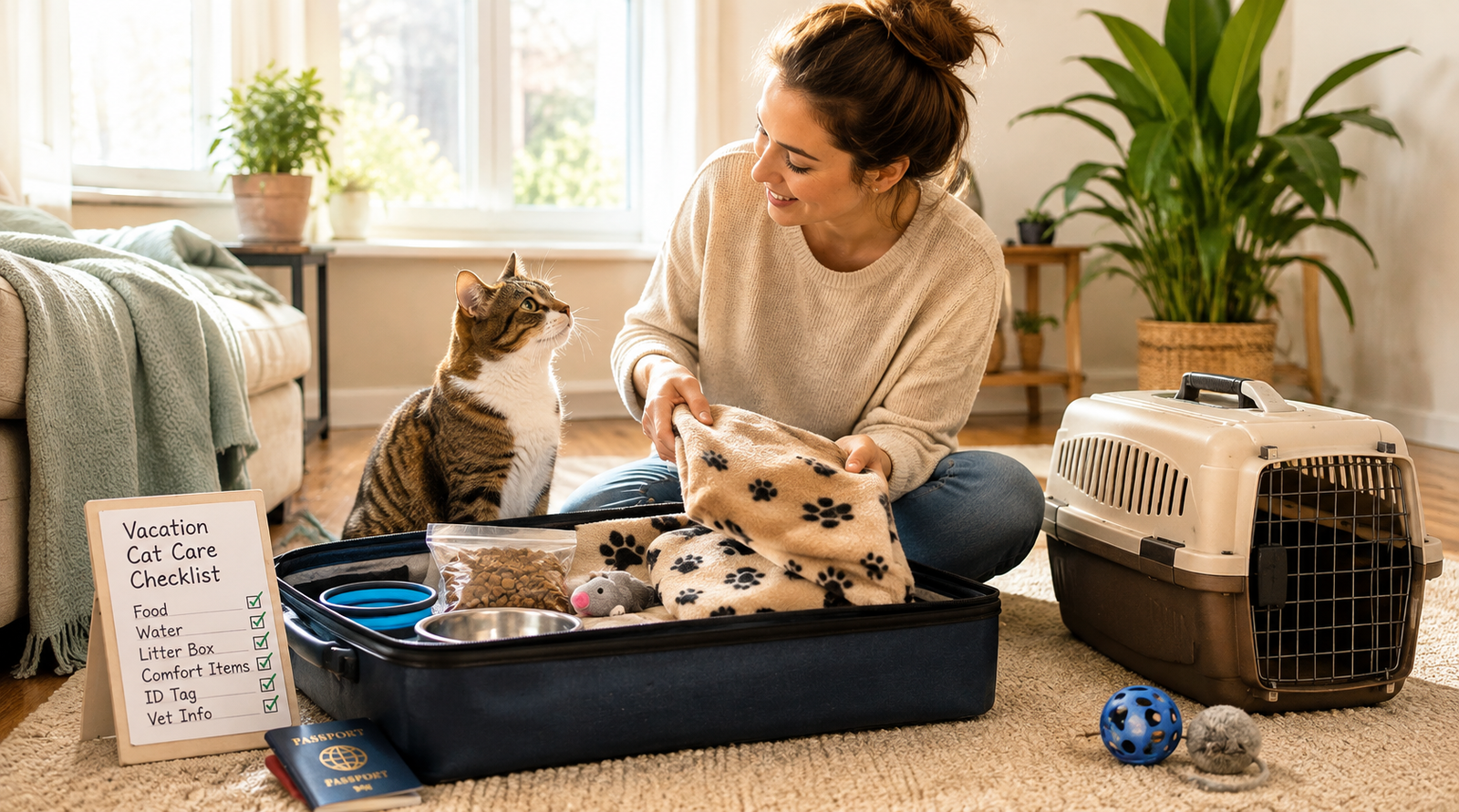
If your cat is traveling with you, prepare a dedicated cat-travel bag.
Include:
- Regular cat food
- Bottled or familiar drinking water where practical
- Food and water bowls
- Usual litter
- Portable litter box
- Waste bags
- Absorbent pads
- Towels or blankets
- Favorite toys
- Medication
- Veterinary records
- ID information
- Microchip details
- Secure carrier
- Cleaning supplies
PetMD recommends bringing cleaning supplies for accidents and taking a litter box and familiar litter when possible on longer road trips.
Keep essential supplies where you can reach them rather than burying them underneath your luggage.
A prepared travel kit makes Vacation Cat Care: Essential Tips for Keeping Your Cat Safe and Happy While You Travel easier because important supplies are available when you need them.
Should You Leave Your Cat Home or Take Them With You?
For many cats, staying home with dependable care is preferable to unnecessary travel.
Cats that are strongly attached to their territory may find a new hotel room, unfamiliar house, car, airport, or airplane more stressful than remaining in familiar surroundings.
On the other hand, some cats may be comfortable traveling, particularly if they have been gradually accustomed to carriers and transportation.
There is no universal answer. Consider your cat’s temperament, age, health, previous travel experience, destination, trip length, and available care.
The safest choice is the one that gives your cat reliable supervision and the fewest unnecessary sources of stress.
That is the central principle behind Vacation Cat Care: Essential Tips for Keeping Your Cat Safe and Happy While You Travel.
Vacation Cat Care Checklist Before You Leave
Use this quick checklist on departure day:
- Confirm your sitter or boarding reservation.
- Leave written feeding and medication instructions.
- Provide your veterinarian’s details.
- Give a backup caregiver access.
- Refresh food and water.
- Clean the litter boxes.
- Secure windows and doors.
- Remove hazardous objects and chemicals.
- Check appliances.
- Set a comfortable indoor temperature.
- Leave familiar toys and bedding.
- Make sure ID information is current.
- Confirm your emergency contact can reach you.
- Tell the sitter how to recognize unusual behavior.
A final walk-through is worth the extra few minutes. It is much easier to spot a loose window screen or forgotten medication before leaving than after your flight has departed.
What to Do When You Return Home
When you get back, let your cat decide how quickly the reunion happens.
Some cats will immediately demand attention. Others may hide, sleep, or act as though they barely noticed you left.
Keep feeding and litter routines normal. Offer affection if your cat wants it, but do not force interaction.
If your caregiver reports unusual eating, drinking, bathroom habits, vomiting, diarrhea, breathing problems, significant lethargy, or other concerning behavior, contact your veterinarian rather than assuming the issue is simply stress.
The goal of Vacation Cat Care: Essential Tips for Keeping Your Cat Safe and Happy While You Travel is not to make the trip completely invisible to your cat. It is to make the experience as safe, predictable, and comfortable as reasonably possible.
FAQs About Vacation Cat Care
1. How do I care for my cat while on vacation?
Arrange reliable daily care, maintain your cat’s normal food and litter routine, provide fresh water, leave emergency instructions, and make sure the home is safe.
2. Can I leave my cat alone for several days?
It is not advisable to leave a cat completely unattended for several days. Cats can become ill, injured, dehydrated, or experience unexpected problems that require human attention.
3. Is a cat sitter better than boarding?
For many cats, a trusted sitter who allows them to remain at home can reduce disruption. Boarding may be appropriate when a cat needs closer supervision or home care cannot be arranged.
4. How often should someone check on my cat?
A dependable caregiver should check on the cat regularly rather than relying only on automatic feeders or cameras. Dr. Elsey’s recommends at least once or twice daily for cats left at home.
5. Should I take my cat on vacation?
Only if traveling is appropriate for your cat. Consider their temperament, health, previous travel experience, transportation method, and destination before deciding.
6. How can I make traveling less stressful for my cat?
Introduce the carrier before the trip, use familiar bedding, maintain familiar food and litter, secure the carrier properly, and ask your veterinarian about anxiety concerns.
7. What should I leave for a cat sitter?
Leave food, litter supplies, medication if needed, written instructions, veterinary information, emergency contacts, carrier access, and details about your cat’s normal behavior.
8. What should I do if my cat becomes stressed while I’m away?
Ask the caregiver to maintain a quiet environment and normal routine while watching for significant behavior or health changes. If concerning symptoms appear, the caregiver should contact your veterinarian.
9. Can I use a camera to monitor my cat?
A pet camera can help you observe your cat, but it should supplement—not replace—physical human care. A camera cannot clean a litter box, refill water after a spill, or respond directly to an injury.
10. How early should I prepare for vacation?
Start planning as soon as your travel dates are confirmed. Give yourself enough time to interview a sitter, arrange boarding if needed, schedule a veterinary appointment, and help your cat become comfortable with a carrier if they are traveling.
Must read our other blogs:
Pet Day Care: Choosing the Best Care for Your Dog