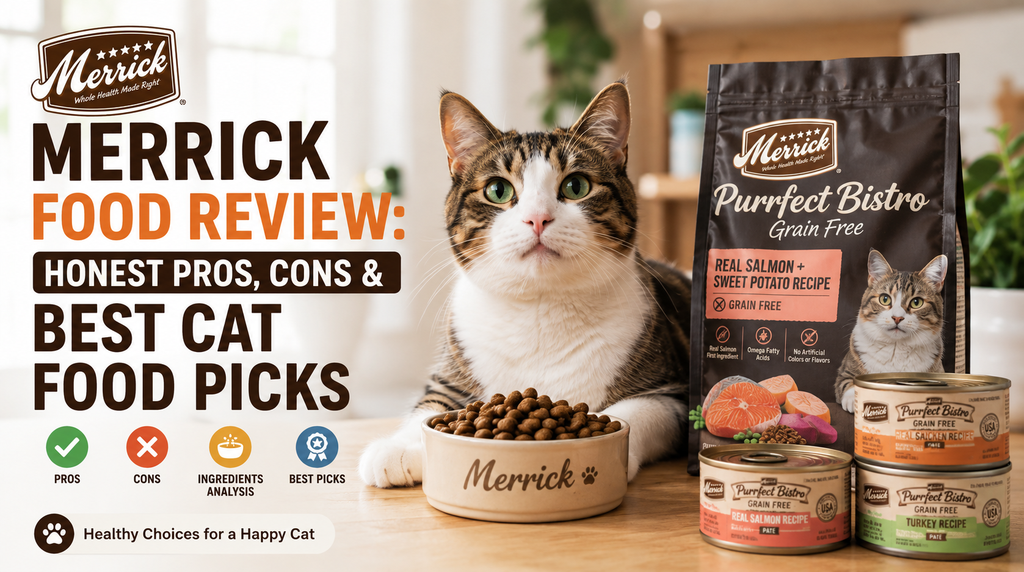
If you’re searching for a merrick food review, the short answer is that Merrick makes some genuinely solid cat foods, but the quality varies by recipe. Its strongest options tend to put recognizable animal proteins near the top of the ingredient list, while some formulas rely more heavily on plant ingredients and starches.
Merrick isn’t automatically the best choice for every cat. The right recipe depends on whether your cat eats wet or dry food, has food sensitivities, needs extra moisture, or simply prefers a particular texture and flavor.
Merrick Cat Food Review: Quick Facts
| Category | Our Assessment |
| Brand | Merrick Pet Care |
| Main cat food lines | Purrfect Bistro, Backcountry, Limited Ingredient Diet |
| Food types | Wet and dry |
| Protein quality | Good to very good, depending on recipe |
| Wet-food quality | Generally stronger than dry formulas |
| Dry-food quality | Good, but some recipes contain substantial plant ingredients |
| Grain-free options | Yes |
| Limited-ingredient options | Yes, although availability can change |
| Artificial colors/flavors/preservatives | Many current recipes are marketed without them |
| AAFCO statement | Current recipes reviewed by the brand are formulated to meet applicable nutritional profiles |
| Overall verdict | Good, but recipe selection matters |
Merrick’s current product catalog includes both wet and dry cat foods, with Purrfect Bistro remaining one of its major cat-food ranges. Current Merrick product information also shows recipes formulated to meet AAFCO Cat Food Nutrient Profiles for their stated life stage.
What Is Merrick Cat Food?
Merrick is an American pet-food brand that produces food and treats for dogs and cats. The brand’s cat-food selection includes wet foods, dry kibble, grain-free recipes, and limited-ingredient formulas.
Merrick’s cat products are currently sold under several lines, including Purrfect Bistro, Backcountry, and Limited Ingredient Diet. The exact recipes and availability can change, so it’s important to judge the individual formula rather than the brand name alone.
One reason Merrick gets attention from cat owners is its emphasis on meat-based ingredients. Some recipes start with ingredients such as deboned chicken, turkey, salmon, tuna, or other animal proteins.
However, that doesn’t mean every Merrick recipe has the same nutritional profile. Dry foods, for example, naturally require more starch than canned food to form kibble.
Merrick Food Review: Ingredient Quality
Ingredient quality is where Merrick becomes more interesting.
Consider a current Merrick Purrfect Bistro grain-free lamb dry recipe. The ingredient list starts with lamb and chicken meal, followed by ingredients such as cassava root flour and potato protein. The guaranteed analysis lists 36% minimum crude protein and 16% minimum crude fat.
Starting with animal ingredients is a positive feature. Lamb and chicken meal can provide concentrated sources of animal protein.
The downside is that the recipe doesn’t stop at meat. Potato protein, pea starch, and other plant ingredients also contribute to the finished food. That’s important because the percentage of protein printed on a label doesn’t tell you how much of that protein comes from animal versus plant sources.
This is one reason I wouldn’t judge Merrick solely by its headline protein percentage.
What About Wet Merrick Food?
Merrick’s wet foods can have a different nutritional profile.
For example, a current Purrfect Bistro tuna pâté lists tuna, tuna broth, chicken, and chicken liver among its first ingredients. It has 10% minimum crude protein, 3% minimum crude fat, and 78% maximum moisture, with 94 calories per can according to Merrick’s product information.
That high moisture content is a major advantage of canned food.
Cats have a relatively low thirst drive compared with many other animals, so incorporating water through food can be useful. Wet food can therefore be particularly attractive for cats that don’t drink much from a bowl.
For owners comparing recipes, I’d generally give greater weight to the ingredient list, moisture level, nutritional adequacy, and your cat’s individual response than to marketing terms such as “premium” or “natural.”
Merrick Purrfect Bistro Review
Purrfect Bistro is one of Merrick’s best-known cat-food ranges.
The current line includes dry recipes featuring proteins such as chicken, lamb, salmon, and ocean fish, as well as wet options. Merrick describes its dry entrées as grain-free and highlights animal protein as the first ingredient in the recipes shown on its current menu.
One strength of the line is variety.
That matters because cats can be extremely selective about food. A brand that offers several proteins and textures gives owners more options when a cat refuses one recipe.
But grain-free does not automatically mean better.
A grain-free recipe can still contain considerable carbohydrates from ingredients such as potatoes, peas, tapioca, cassava, or other starch sources. For that reason, “grain-free” shouldn’t be used as a shortcut for determining nutritional quality.
Merrick Backcountry: Is It Worth Considering?
Backcountry is positioned as a more specialized Merrick range and includes grain-free recipes.
The appeal is easy to understand: recipes may emphasize meat-based ingredients and, depending on the product, can offer textures and formulations different from standard kibble.
For cats that prefer wet food, however, the specific moisture content remains more important than the Backcountry name itself.
When comparing two products, check the guaranteed analysis and ingredients on the actual package. Formulas can change, and different recipes within the same product family aren’t nutritionally identical.
Merrick Limited Ingredient Diet Review
The Limited Ingredient Diet range is designed around simpler ingredient lists and specific animal protein sources.
This can be useful when you’re trying to identify foods your cat tolerates well. A recipe built around one primary animal protein can make the elimination process more straightforward than a food containing chicken, turkey, salmon, and several other proteins.
But “limited ingredient” doesn’t mean a food is automatically appropriate for a cat with a diagnosed allergy.
Food allergies and gastrointestinal problems should be evaluated with a veterinarian. A cat experiencing repeated vomiting, diarrhea, weight loss, or refusal to eat shouldn’t simply be switched from one commercial food to another without addressing the underlying problem.
What I Like About Merrick Cat Food
1. Strong animal ingredients in many recipes
Several Merrick recipes begin with identifiable meat or fish ingredients. That’s a useful starting point when comparing cat foods.
2. Good wet-food options
Merrick’s pâtés and other wet recipes can provide substantial moisture while supplying animal-derived protein.
3. Plenty of variety
Owners can choose from different proteins, textures, and food formats. That is particularly useful for picky cats.
4. Clear nutritional information
Merrick publishes guaranteed analyses and feeding directions for its current products. For example, its lamb dry recipe provides protein, fat, fiber, taurine, fatty-acid, mineral, and calorie information.
5. Some recipes avoid common grain ingredients
For owners specifically looking for grain-free food, Merrick provides multiple options.
That said, grain-free should be treated as a preference or specific dietary consideration—not proof that a recipe is nutritionally superior.
What I Don’t Like About Merrick
1. Recipe quality isn’t consistent
This is probably the biggest issue.
A cat food brand can have one excellent recipe and another that is merely average. Merrick is no exception.
Some dry recipes include plant proteins or starches relatively high on the ingredient list. That doesn’t automatically make the food unsafe, but it can make the recipe less appealing if your goal is a highly animal-protein-focused diet.
2. Dry food is still dry food
Even a good kibble doesn’t provide the same amount of water as canned food.
Merrick itself recommends combining dry and canned foods where possible to increase dietary water intake.
3. Some recipes contain ingredients certain owners prefer to avoid
Depending on the formula, you may see ingredients such as pea protein, potato protein, gums, or other functional ingredients.
Whether an individual ingredient is acceptable depends on the whole diet and your cat’s needs. Avoiding an ingredient simply because its name sounds unfamiliar isn’t a reliable way to evaluate pet food.
4. Customer experiences are mixed
Consumer reviews should not be treated as controlled nutritional or safety studies, but they can highlight recurring customer concerns.
ConsumerAffairs currently displays a mix of positive and negative Merrick experiences, including complaints about recipe changes, food acceptance, packaging, and digestive problems. Those are customer reports rather than proof that Merrick food caused a particular medical condition.
Has Merrick Cat Food Been Recalled?
Merrick has had recalls involving pet products, but it’s important to distinguish cat food recalls from recalls involving other products.
The FDA records a 2018 voluntary recall involving specific Merrick Backcountry beef dog treats because of potentially elevated levels of naturally occurring beef thyroid hormone. The FDA states that the recall was limited to specified production codes and that no other Merrick or Castor & Pollux products were affected.
The FDA also maintains records of consumer adverse-event reports. Such reports are not the same thing as confirmed recalls or proof of causation.
This distinction matters because online discussions sometimes turn an individual complaint into a claim that an entire brand has been recalled. Those are very different things.
If you’re buying Merrick today, check the package, product code, and current manufacturer information rather than relying on an old social-media post.
What Customers Say About Merrick
Customer feedback is unusually mixed.
Some owners report that their cats enjoy Merrick and have eaten it successfully for years. Others report problems such as refusing a changed recipe, vomiting, digestive upset, or concerns about packaging.
ConsumerAffairs currently lists 49 reviews with a 1.0 rating on its page as of its August 17, 2026 update, but this should be interpreted cautiously because review-site ratings represent the experiences of people who chose to submit reviews and aren’t a scientific measure of the food’s nutritional quality.
For a detailed independent ingredient and nutrition breakdown, you can also read the Merrick Cat Food Review from Cats.com.
The important takeaway is simple: customer reviews are useful for spotting patterns, but they cannot establish that a food caused a medical problem.
Is Merrick Cat Food Good for Cats?
Yes, Merrick can be a good choice for many cats, but the specific recipe matters more than the brand name.
If I were choosing from the range, I’d pay particular attention to:
- The first five ingredients
- The primary animal protein
- Moisture content
- Protein and fat levels
- Whether plant proteins are contributing heavily to total protein
- Your cat’s age and life stage
- Any known food sensitivities
- Your veterinarian’s recommendations
For many healthy adult cats, a moisture-rich Merrick wet formula may be a more attractive everyday option than relying entirely on dry kibble.
For dry food, Merrick can still be reasonable, but I’d pay closer attention to carbohydrate-producing ingredients and plant protein sources.
Merrick Wet Food vs. Dry Food
| Feature | Merrick Wet Food | Merrick Dry Food |
| Moisture | High | Low |
| Convenience | Moderate | High |
| Storage after opening | Requires refrigeration | Easier |
| Hydration support | Excellent | Limited |
| Protein quality | Recipe-dependent | Recipe-dependent |
| Carbohydrates | Usually lower | Usually higher |
| Best for | Cats needing more dietary moisture | Convenience and mixed feeding |
Neither format is automatically perfect.
A mixed-feeding approach can make sense for some households, particularly when the cat enjoys both formats and the overall daily diet is nutritionally complete and appropriately portioned.
How to Choose the Best Merrick Recipe
Start with your cat, not the package.
For a healthy cat that loves pâté, choose a complete-and-balanced wet recipe your cat reliably eats. If your cat prefers kibble, look for a formula where animal proteins are prominent and avoid assuming that a high crude-protein number tells the entire story.
For a cat with suspected food sensitivity, don’t randomly rotate through numerous proteins. Work with your veterinarian to determine whether a controlled diet trial is appropriate.
And always transition gradually. Merrick recommends a 7–10 day transition period for at least some of its current products, gradually increasing the new food while decreasing the old one.
Merrick Food Review: Final Verdict
After looking at the current formulas, ingredient profiles, customer feedback, and safety information, my verdict is good but selective.
Merrick deserves consideration because many recipes feature recognizable animal proteins, provide complete-and-balanced nutrition for their stated life stages, and offer useful wet-food options.
The biggest mistake would be treating every Merrick product as identical.
A meat-forward wet recipe can be a very different nutritional proposition from a dry recipe that contains several starches and plant protein ingredients. Likewise, a limited-ingredient formula serves a different purpose from a multi-protein recipe.
So, is Merrick cat food good? Yes—some Merrick recipes are very good, while others are simply average.
If your cat enjoys the food, maintains a healthy body condition, has normal stools, and is eating a nutritionally complete recipe appropriate for its life stage, Merrick can fit comfortably into a sensible feeding plan.
FAQs
Is Merrick cat food healthy?
Merrick makes complete-and-balanced cat foods for their stated life stages, but nutritional quality varies between recipes. Check the individual ingredient list and guaranteed analysis rather than judging the whole brand.
Is Merrick owned by Purina?
Merrick’s acquisition by Nestlé Purina was announced in 2015. Merrick continued as a pet-food brand under the larger company.
Is Merrick Purrfect Bistro good cat food?
Purrfect Bistro has several worthwhile recipes, particularly for owners looking for meat-based wet or dry options. However, individual formulas differ, so the ingredient panel should be checked before buying.
Does Merrick make grain-free cat food?
Yes. Merrick currently offers multiple grain-free cat-food recipes, including products within its Purrfect Bistro range.
Is Merrick wet food better than dry food?
Not automatically, but wet food generally provides much more moisture. For cats that don’t drink much, this can be a meaningful advantage.
Does Merrick cat food contain taurine?
Yes. Current Merrick cat-food formulas include taurine in their ingredient or guaranteed-analysis information. For example, Merrick’s current lamb dry recipe lists taurine at a minimum of 0.2%.
Has Merrick cat food been recalled?
Merrick has had recalls involving certain pet products, including a 2018 recall of specific beef dog treats. That recall did not cover all Merrick products.
Is Merrick good for picky cats?
It can be. The brand offers multiple proteins and textures, giving owners more options. However, individual cats have very different preferences, so no brand can guarantee acceptance.
Should I switch my cat to Merrick immediately?
No. Sudden food changes can cause digestive upset. Merrick recommends gradually transitioning to its food over approximately 7–10 days for its current products.
What is the best Merrick cat food?
There isn’t one universal best recipe. For many cats, a complete-and-balanced wet formula with a high moisture content and a suitable animal protein can be a strong choice. Your cat’s age, health, preferences, and veterinarian’s advice should determine the final selection.
Must read our other blogs:
Is Orijen Cat Food Good? An Honest 2026 Guide & Review