A remote dog training collar lets you send a signal — vibration, tone, or a low static stimulation — to your dog from a distance, mainly to reinforce recall and off-leash manners. The right one comes down to seven things: stimulation range, level count, mode variety, fit, range, waterproofing, and battery life. Get those wrong and the collar becomes frustrating or unsafe; get them right and it becomes a genuinely useful communication tool.
This guide breaks down exactly what to check before you buy, how these collars actually work, and where trainers and veterinary behaviorists still disagree.
Remote Dog Training Collar: Quick Facts
| Category | Details |
| Main purpose | Reinforce commands (recall, heel, stay) at a distance using vibration, tone, or static stimulation |
| Best suited for | Dogs that already know basic obedience and need off-leash reliability |
| Typical range | ¼ mile to 1 mile, line-of-sight |
| Key features to check | Stimulation levels, momentary/continuous mode, waterproofing, fit, range, battery, size |
| Not recommended for | Puppies under basic training age, fearful/anxious dogs, or as a first-line fix without obedience foundations |
| Important consideration | Veterinary behavior organizations, including AVSAB, favor reward-based training and caution against aversive tools as a starting point |
What Is a Remote Dog Training Collar?
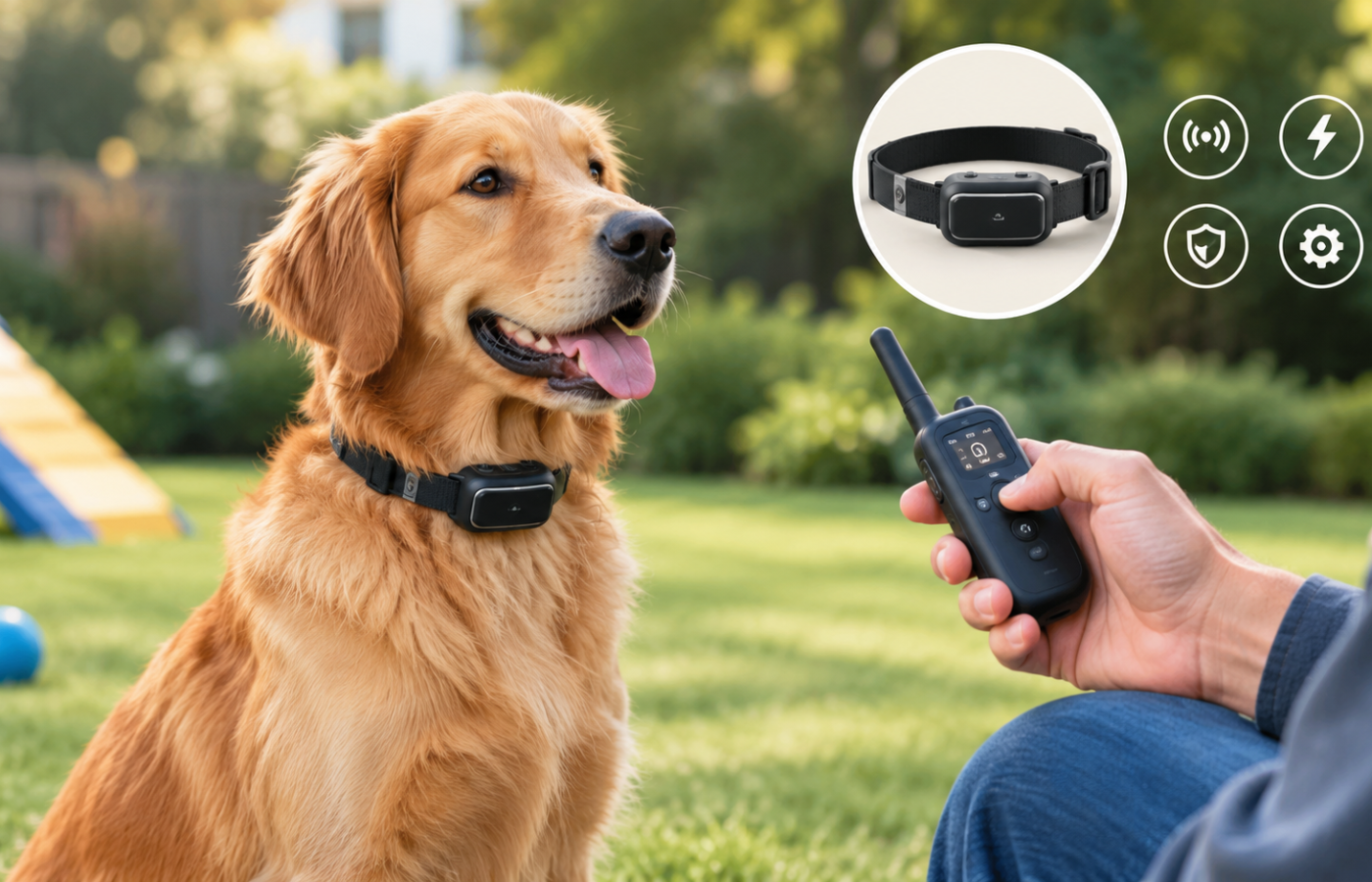
A remote dog training collar is a two-part system: a handheld transmitter you carry and a receiver collar worn around the dog’s neck. Pressing a button on the transmitter sends a signal to the receiver, which delivers a vibration, an audible tone, or a static (electrical) stimulation.
These are sometimes called “e-collars” or, less accurately, “shock collars.” Reputable modern units are adjustable across dozens of intensity levels, and manufacturers describe the sensation at low settings as closer to a muscle tap than a shock — though the terminology and welfare implications remain genuinely debated, which we’ll cover below.
How Does a Remote Dog Training Collar Work?
The transmitter sends a radio-frequency signal to the collar receiver, which then triggers the chosen stimulation type at the level you’ve set. Most systems offer three modes: tone (a beep), vibration (a buzz), and static stimulation (a brief electrical pulse felt through metal contact points against the skin).
Trainers typically use it to reinforce a command the dog already knows — not to teach a new one. For example, a dog conditioned to associate a light vibration with “come” will respond to that vibration even when distracted or out of earshot. The operating range depends on line of sight, meaning performance is best on open, flat terrain with no obstacles between the transmitter and the collar. sportdog
7 Key Features to Look For in a Remote Dog Training Collar
1. Number of Stimulation Levels
More levels mean finer control. A collar with only 5–10 levels can jump from “nothing” to “too much” with no middle ground. Look for a wide adjustable range so you can find the lowest level your dog notices — that’s the goal, not the highest one.
2. Multiple Modes (Tone, Vibration, Static)
A good collar should offer all three options, not just static stimulation. Many dogs respond fully to tone or vibration alone once conditioned, and having the choice lets you use the mildest effective option for your individual dog.
3. Momentary vs. Continuous Stimulation
“Momentary” (sometimes called “nick”) delivers a quick, half-second pulse. “Continuous” holds the stimulation while the button is pressed. Trainers generally favor momentary stimulation for corrections and reserve continuous only for specific, controlled situations — a feature that lets you choose matters.
4. Range That Matches Your Use Case
Manufacturer-stated ranges (often ½ mile to 1 mile) assume open, obstacle-free terrain. If you’re training in wooded areas, near buildings, or on hilly ground, actual usable range will be shorter, so it’s worth buying more range than you think you’ll need.
5. Waterproof Rating
Dogs get wet — puddles, rain, swimming. A collar and transmitter with a genuine waterproof (not just water-resistant) rating avoids malfunction and reduces the risk of skin issues from a soggy collar left on too long.
6. Proper Fit and Contact Point Options
The collar should sit snugly enough that the contact points stay in touch with the skin, but loose enough to fit two fingers underneath. Dogs with thick or long coats often need longer contact points or flexible adapters; short-haired dogs typically do fine with standard or padded contacts.
7. Size and Weight Appropriate for the Dog
A receiver built for a large working breed can be uncomfortably bulky on a small dog. Check the manufacturer’s minimum neck size and dog weight recommendations before buying — “one size fits all” rarely does with e-collars.
Benefits of a Remote Dog Training Collar
- Off-leash reliability. For dogs with solid obedience foundations, it reinforces recall in real-world distractions like wildlife, other dogs, or traffic.
- Consistent, immediate feedback. Because it works at a distance, you can respond to a behavior the instant it happens, which matters for timing-sensitive corrections.
- Reduced reliance on leash-only control. For hunting, field work, or large properties, it extends the range at which you can communicate with your dog.
- Adjustable to the individual dog. With enough levels and modes, it can be tailored to a dog’s temperament rather than using a one-size-fits-all correction.
Potential Drawbacks and Risks
- Skin irritation from poor fit. A collar worn too tight, too loose, or left in one spot for days can cause pressure sores or contact irritation — largely preventable with correct fit and by rotating collar position.
- Ineffective or harmful use without proper introduction. Using stimulation before a dog understands basic commands, or before it’s been desensitized to wearing the collar, can create confusion, fear, or avoidance rather than learning.
- Welfare concerns from veterinary behavior organizations. The American Veterinary Society of Animal Behavior (AVSAB) has published position statements favoring reward-based training and cautioning against aversive tools, including electronic collars, citing risks of fear, anxiety, and strained human-dog trust when used incorrectly. This is a genuinely contested area — many trainers who use e-collars argue that low-level, well-conditioned stimulation is not equivalent to punishment-based shock, while behaviorist organizations largely disagree with that framing.
- Not a substitute for training. The collar reinforces a command; it doesn’t teach one on its own.
Is a Remote Dog Training Collar Good for Dogs?
It depends heavily on the dog, the situation, and how it’s introduced. For an adult dog with basic obedience already in place, a well-fitted collar used at the lowest effective level, alongside reward-based reinforcement, can support off-leash safety. For puppies, fearful or anxious dogs, or as a first response to a behavior problem, most professional trainers and veterinary behaviorists recommend starting with reward-based methods instead.
If you’re unsure whether it’s appropriate for your dog, a certified professional trainer or veterinary behaviorist can assess temperament and training history before you introduce one.
Remote Training Collar vs. Other Training Tools
| Tool | Best For | Range | Learning Curve |
| Remote training collar | Reinforcing known commands at distance | Up to ~1 mile | Moderate–high (requires conditioning) |
| Standard leash & harness | Everyday walking, basic obedience | Arm’s length | Low |
| Long line (15–50 ft) | Recall practice in controlled areas | Line length | Low |
| Clicker & treats | Teaching new behaviors from scratch | Close range | Low–moderate |
| GPS/vibration-only collar | Location tracking + mild attention cue | Varies by model | Low |
Frequently Asked Questions
Are remote dog training collars cruel?
Not inherently — it depends on the settings, the fit, and whether the dog was properly conditioned first. However, some veterinary behavior organizations, including AVSAB, advise against aversive tools generally, so opinions among professionals differ.
What is the difference between a shock collar and an e-collar?
The terms are often used interchangeably, but “e-collar” usually refers to adjustable, multi-mode modern units with dozens of stimulation levels, while “shock collar” is sometimes used for cheaper, less precise devices with limited settings.
What range do I need for a remote dog training collar?
For yard or neighborhood training, a ¼-to-½-mile range is usually enough. For hunting or large open properties, ¾ mile or more gives you a safety margin, since actual range shrinks with obstacles and terrain.
How many stimulation levels should a good e-collar have?
Look for at least 10–20 adjustable levels at minimum; many quality collars offer far more, which allows finer tuning to your dog’s sensitivity.
Can a puppy wear a remote training collar?
Most trainers recommend waiting until a puppy has learned basic obedience (sit, come, stay) and reached a minimum age and weight set by the manufacturer before introducing any stimulation-based tool.
Do veterinarians recommend e-collars?
Veterinary behavior organizations generally favor reward-based training first and recommend against aversive tools as a default approach; individual veterinarians’ views can vary, so it’s worth discussing your specific dog with your vet.
How long can a dog wear a training collar each day?
It should be removed during rest periods and not left on for extended stretches (often cited as no more than 8–10 hours), with the collar position rotated to avoid irritation in one spot.
What is the best remote dog training collar for beginners?
Beginners generally do best with a collar that has a simple interface, tone and vibration modes in addition to static stimulation, and a moderate range — allowing you to start with the mildest options while you learn the conditioning process.
Do remote training collars work for all breeds?
Any breed can technically wear one, but coat type, temperament, and sensitivity all affect what fit, contact points, and stimulation level are appropriate.
Should I hire a trainer before using an e-collar?
Yes — most manufacturers and trainers recommend working with a professional at least initially, since improper introduction is the most common cause of poor results or stress in the dog.
Must read our other blogs:
Nashua Pet Care Clinic: Trusted Veterinary Care for Pets of All Ages