
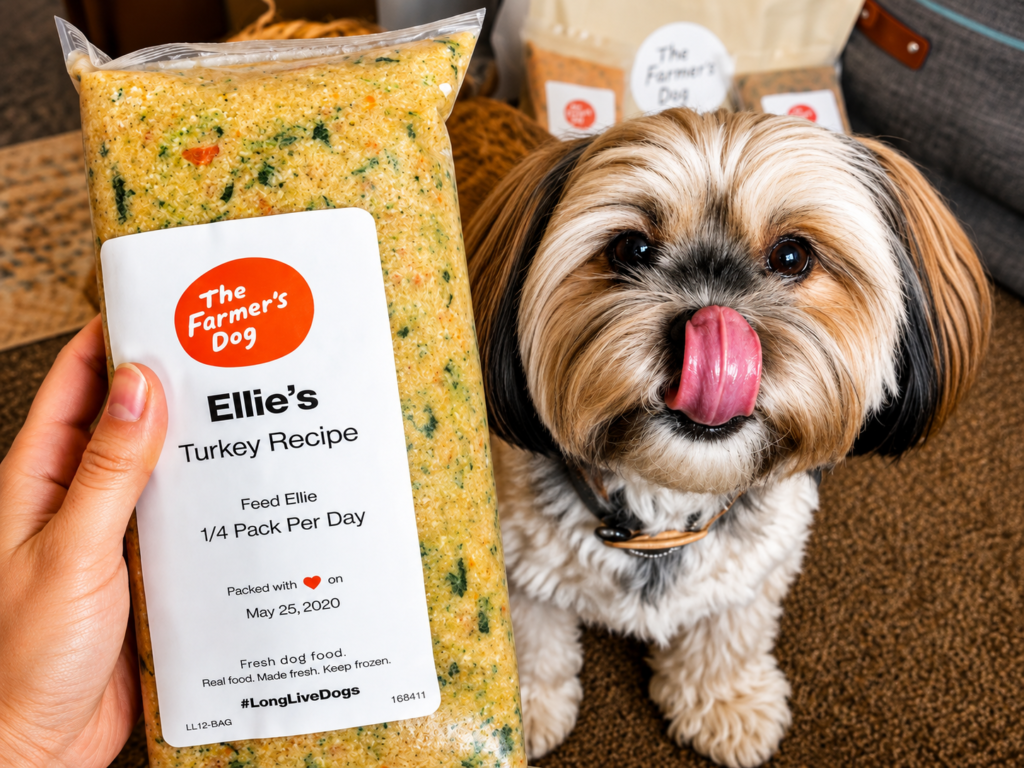
If you are researching The Farmer’s Dog Food, the short answer is that it is a premium fresh dog food service built around gently cooked meals, recognizable ingredients, personalized portions, and home delivery. The company says its recipes are formulated by board-certified veterinary nutritionists and are complete and balanced according to AAFCO standards. The Farmer’s Dog official website
But a good ingredient list is only part of the decision. Price, storage, convenience, nutritional adequacy, your dog’s preferences, and your ability to maintain the diet long term all matter. Here is a closer look at The Farmer’s Dog Food ingredients, recipes, benefits, drawbacks, and overall value.
The Farmer’s Dog Food: Quick Facts
| Feature | Details |
| Brand | The Farmer’s Dog |
| Food type | Fresh dog food |
| Main formats | Frozen Fresh and Instant Fresh |
| Cooking method | Gently cooked |
| Proteins | Beef, chicken, turkey, pork and other recipe options |
| Nutrition | Complete and balanced recipes |
| Formulation | Board-certified veterinary nutritionists |
| Grain options | Grain-inclusive and grain-free |
| Portioning | Personalized according to the dog’s needs |
| Delivery | Subscription-based home delivery |
| Main advantage | Fresh, pre-portioned meals |
| Main drawback | Higher cost than many conventional foods |
The Farmer’s Dog currently offers two main formats. Frozen Fresh is its original refrigerated/frozen meal option, while Instant Fresh is shelf-stable and prepared by adding water before serving.
The company says its meals are made in human-food facilities and prepared according to human-grade safety standards. Frozen Fresh meals are gently cooked and quickly frozen, while Instant Fresh uses a low-heat drying process.
What Is The Farmer’s Dog?
The Farmer’s Dog Food is a direct-to-consumer dog food service that focuses on fresh, personalized meals instead of traditional dry kibble.
When you create a meal plan, you provide information about your dog, including factors such as age, breed, weight, activity level, and body condition. The company then recommends portions based on the dog’s estimated calorie needs.
This personalized approach is one of the brand’s biggest differences from conventional dog food. Rather than buying one formula and estimating portions yourself, the meals arrive pre-portioned.
The company says the plans can be adjusted as a dog’s needs change. That can be useful for growing puppies, older dogs, or dogs whose activity level changes during the year.
The Farmer’s Dog Ingredients: What Is Inside?
One of the main reasons owners consider The Farmer’s Dog Food is its ingredient list.
The recipes use recognizable animal proteins and vegetables, along with vitamins and minerals needed to create a nutritionally complete diet. Current protein options include beef, chicken, turkey, and pork.
The company says every recipe is formulated to be complete and balanced under AAFCO standards. It also offers both grain-inclusive and grain-free options.
The exact ingredients depend on the recipe recommended for your dog, so owners should check the specific ingredient panel rather than assuming every formula has the same composition.
Another term you will see frequently is human-grade.
That term has a specific meaning in pet food. It is not simply another way of saying that ingredients look healthy. AAFCO guidelines require a human-grade claim to apply to the finished pet-food product and its handling, processing, storage, and transportation.
The Farmer’s Dog says its meals are produced in facilities that meet human-food standards and that its ingredients are tested for quality and safety.
Is The Farmer’s Dog Complete and Balanced?
According to the company, its recipes are developed and reviewed by board-certified veterinary nutritionists and formulated to meet AAFCO nutritional standards.
This is important because a homemade-looking meal is not automatically a nutritionally complete diet.
Dogs need the correct balance of protein, fat, carbohydrates, vitamins, minerals, and other nutrients. Simply combining meat and vegetables at home can create nutritional gaps.
The Farmer’s Dog Food takes a different approach because the company formulates its recipes around established nutritional requirements rather than expecting owners to balance meals themselves.
The company also reports conducting feeding and digestibility research on its recipes. These studies are useful supporting evidence, but they should not be interpreted as a guarantee that every dog will experience the same health results.
Dogs have different nutritional requirements. A dog with a diagnosed medical condition may need a veterinary therapeutic diet or individualized nutritional advice.
The Farmer’s Dog Recipes
The Farmer’s Dog offers several fresh recipes with different protein sources. Beef, chicken, turkey, and pork are among the proteins used across its recipes.
The company also provides grain-inclusive and grain-free choices.
That variety can be helpful when a dog has strong food preferences or when an owner wants to avoid a particular ingredient. Turkey and pork may also be considered novel proteins for some dogs, depending on what they have previously eaten.
However, grain-free should not automatically be interpreted as healthier.
Unless a veterinarian has identified a specific reason to avoid certain grains, there is no need to assume that grain-free food is superior simply because it sounds more natural or premium.
The better question is whether the complete recipe provides appropriate nutrition for the individual dog.
The Farmer’s Dog Food Pros
The Farmer’s Dog Food offers several practical benefits for owners who prefer fresh meals.
1. Recognizable ingredients
The meals contain recognizable proteins and vegetables instead of the dry pellet format associated with traditional kibble. For owners who prefer a whole-food appearance, this can be appealing.
2. Personalized portions
The Farmer’s Dog calculates portions using information about the individual dog. Age, weight, breed, activity level, and body condition can all influence calorie requirements.
This may make feeding easier for owners who are unsure how much food their dog actually needs.
3. Pre-portioned meals
Convenience is another major advantage. Instead of weighing ingredients or preparing homemade meals, owners can open a portion and serve it according to the feeding instructions.
4. Fresh-food format
Frozen Fresh is gently cooked rather than processed into conventional kibble. The company says this method is designed to maintain the nutritional value and moisture of the ingredients while providing a safe cooked product.
5. Multiple recipes
Different proteins and grain options give owners more flexibility than a single-formula diet.
6. Home delivery
For people who dislike carrying heavy dog-food bags home from a store, scheduled delivery can be a real convenience.
The Farmer’s Dog Food Cons
Like any premium diet, The Farmer’s Dog Food also has some disadvantages to consider.
1. It is expensive
The biggest concern for many owners will be price.
The company says plans start at approximately $2 per day, but actual pricing depends on the dog’s size, age, recipe, activity level, and nutritional needs.
A small dog may be relatively affordable compared with feeding a large dog. Owners with multiple large dogs should expect the food budget to be considerably higher.
Because prices are personalized, the most accurate way to estimate your cost is to complete the company’s meal-plan questionnaire.
2. Frozen food requires storage
Frozen Fresh is perishable and needs appropriate refrigerator or freezer storage.
That can be inconvenient for people with limited freezer space. A large dog can also require substantially more food than a small dog, making storage more important.
3. It requires more planning than kibble
Kibble can sit in a sealed bag at room temperature. Fresh food cannot be treated the same way.
Frozen meals need to be stored safely and thawed before feeding. Owners therefore need to plan ahead.
4. Subscription feeding is not for everyone
The subscription model is convenient for some households but unnecessary for others.
If you prefer buying food whenever you visit a pet store, recurring deliveries may feel less flexible. On the other hand, automatic delivery can help prevent last-minute food shortages.
Is The Farmer’s Dog Worth It?
The Farmer’s Dog Food can be worth the higher price if fresh food, personalized portions, ingredient transparency, and delivery are important to you.
It is less attractive if your main priority is minimizing the cost of feeding your dog.
The value also depends on your dog’s response. A premium food does not help much if your dog refuses to eat it, gains too much weight, develops digestive problems, or the household cannot manage the storage requirements.
For owners who have the budget and want a fresh alternative to conventional kibble, the service has several practical advantages. The meals are pre-portioned, recipes are designed to be complete and balanced, and the company works with veterinary nutrition professionals.
Still, “fresh” does not automatically mean every dog needs it. A properly formulated conventional diet can also meet a dog’s nutritional requirements.
The best choice is the food your dog can eat consistently, that meets their nutritional needs, and that you can realistically afford over the long term.
The Farmer’s Dog vs. Traditional Kibble
| Factor | The Farmer’s Dog | Traditional Kibble |
| Format | Fresh meals | Dry food |
| Processing | Gently cooked / dried depending on format | Usually highly processed |
| Storage | Refrigeration/freezing for Frozen Fresh | Usually room temperature |
| Portions | Personalized | Owner-measured |
| Delivery | Subscription available | Usually bought as needed |
| Cost | Premium | Wide range |
| Preparation | Thaw or add water | Scoop and serve |
| Recipe choices | Multiple fresh recipes | Many brands and formulas |
The biggest difference is therefore not simply “fresh versus dry.” It is the entire feeding experience.
The Farmer’s Dog combines personalized meal planning, fresh preparation, portion control, and delivery. Kibble offers simplicity, long shelf life, easy storage, and usually a lower price.
Who Should Consider The Farmer’s Dog?
The Farmer’s Dog Food may be a good fit for owners who:
- Prefer fresh dog food.
- Want recognizable meat and vegetable ingredients.
- Have a picky eater.
- Like pre-portioned meals.
- Want food delivered to their home.
- Have enough refrigerator or freezer space.
- Can comfortably afford a premium food.
- Prefer having a professionally formulated recipe rather than creating homemade meals themselves.
It may not be the best fit for owners who are working with a very tight food budget, have limited freezer space, or want the simplest possible storage solution.
Final Verdict: Is The Farmer’s Dog Good?
Overall, The Farmer’s Dog Food is a strong premium fresh-food option, but whether it is worth the price depends on your dog and your household.
Its strongest points are its fresh-food format, recognizable ingredients, personalized portions, veterinary nutritionist involvement, and convenient delivery.
Its biggest disadvantages are the higher cost, storage requirements, and the extra planning that comes with perishable food.
The most important thing is not whether a food looks premium. Look at the complete nutritional profile, feeding instructions, ingredient list, manufacturing standards, and whether the diet fits your individual dog.
If those factors line up with your needs and budget, The Farmer’s Dog is a reasonable fresh-food option to consider.
FAQs
Is The Farmer’s Dog actually good for dogs?
The company says its recipes are formulated by board-certified veterinary nutritionists and are complete and balanced according to AAFCO standards. Whether a particular recipe is appropriate still depends on the individual dog’s needs.
What ingredients are in The Farmer’s Dog?
The recipes use animal proteins such as beef, chicken, turkey, and pork along with vegetables, vitamins, and minerals. Ingredients vary by recipe.
Is The Farmer’s Dog human-grade?
The Farmer’s Dog says its finished food is made according to human-food safety and quality standards. Human-grade is a regulated pet-food claim with specific requirements rather than simply a marketing description.
Is The Farmer’s Dog worth the money?
It can be worth it for owners who prioritize fresh food and convenience and can afford the premium price. It may not be worthwhile for owners mainly looking for the lowest-cost dog food.
Does The Farmer’s Dog have grain-free recipes?
Yes. The company offers both grain-inclusive and grain-free recipe options.
Does The Farmer’s Dog need to be refrigerated?
Frozen Fresh meals need refrigeration or freezer storage. The newer Instant Fresh format is shelf-stable and is prepared by adding water.
Is The Farmer’s Dog good for picky eaters?
Fresh food can be appealing to some picky dogs, but there is no guarantee that every dog will prefer it. Individual taste varies.
Can puppies eat The Farmer’s Dog?
The company says its Frozen Fresh recipes are suitable for different life stages, including puppies. Puppies have specific growth requirements, so owners should follow the recommended feeding plan and consult a veterinarian when necessary.
Is fresh dog food better than kibble?
Not automatically. Fresh food offers a different preparation and feeding format, but nutritional completeness and suitability for the individual dog matter more than whether the food is simply labeled fresh.
How much does The Farmer’s Dog cost?
The company says plans start at around $2 per day, but the actual price depends on the dog’s size, age, recipe, activity level, and nutritional requirements. An individualized quote is more useful than a generic monthly estimate.
Must read our other blogs:
Why Does My Dog Lick My Ankles? 7 Surprising Reasons





Leave a Reply