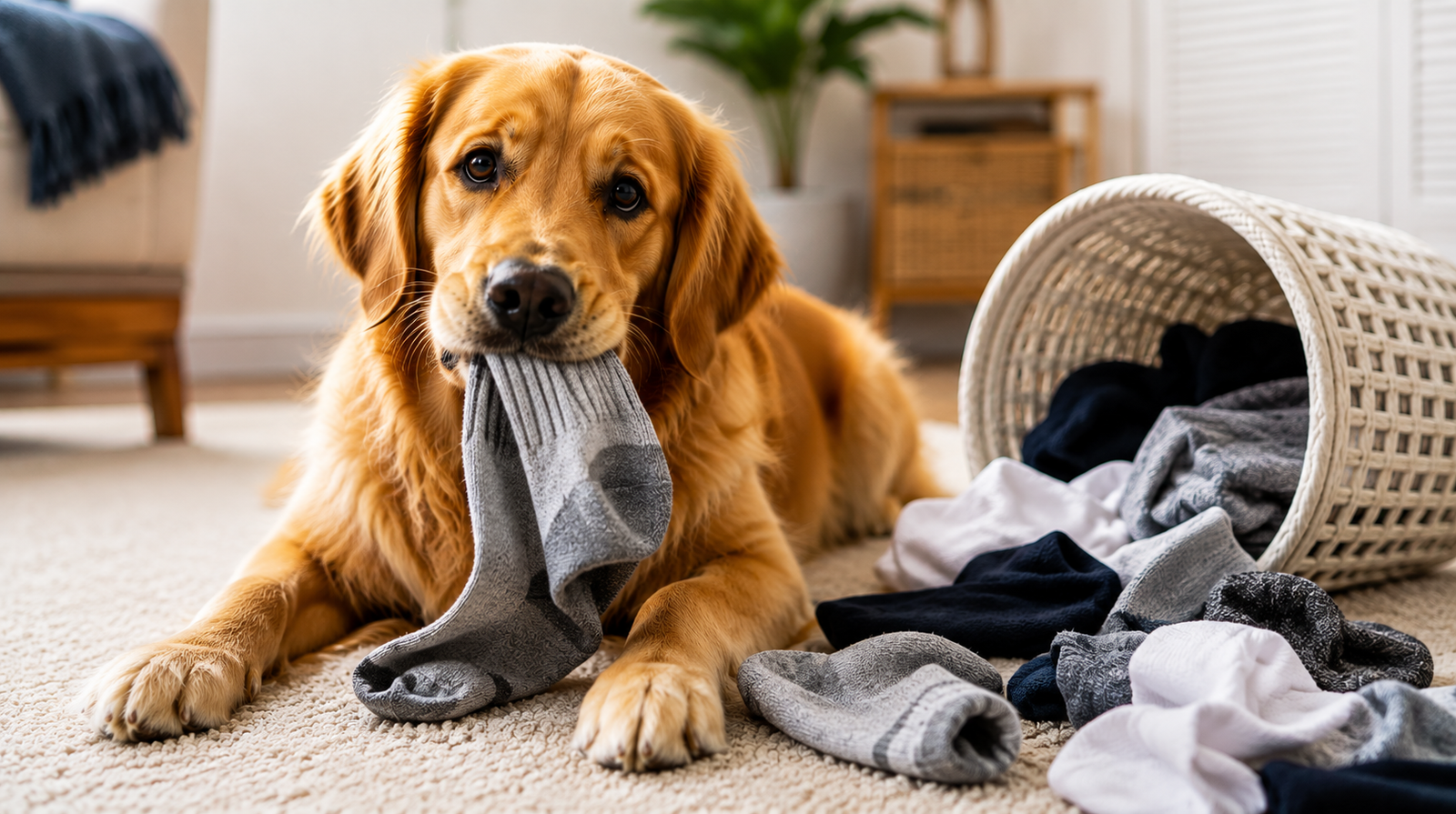
If you keep asking, “Why does my dog steal my socks?”, the answer is usually a combination of scent, texture, curiosity, attention, and natural chewing behavior. Your socks carry your familiar smell, are easy for a dog to grab, and can become especially appealing when your dog is bored, teething, or looking for interaction.
The behavior can be funny when your dog proudly parades around with one sock. But if your dog chews or swallows socks, it can become a serious safety issue because fabric can cause choking or an intestinal blockage.
Why Does My Dog Steal My Socks? Quick Answer
The most common reasons include:
| Reason | What it means |
| Your scent | Socks carry a strong, familiar smell |
| Comfort | Your scent may make your dog feel secure |
| Texture | Soft, stretchy fabric is fun to carry and chew |
| Boredom | Your dog may be creating its own entertainment |
| Attention | Chasing your dog can accidentally reward the behavior |
| Teething | Puppies may seek soft objects to chew |
| Learned habit | Stealing socks can become a rewarding game |
Not every dog steals socks for the same reason. Pay attention to when, where, and what your dog does with the sock. A dog that carries it gently may have a different motivation from a dog that immediately tears it apart or tries to swallow it.
1. Your Socks Smell Like You
One of the simplest answers to why does my dog steal my socks is scent.
Dogs experience much of their environment through smell. A worn sock contains familiar odors from the person who wore it, making it far more interesting to a dog than a clean piece of fabric sitting in a drawer.
Nylabone notes that dogs may be attracted to socks because they carry the scent of their favorite people. That familiar smell can also make the object comforting.
This can explain why your dog ignores a brand-new pair but suddenly becomes obsessed with the socks you just took off.
Your dog isn’t necessarily thinking, “I want to destroy this.” It may simply be investigating an object that strongly smells like someone it knows.
2. Your Dog May Find Socks Comforting
Some dogs don’t chew the sock at all. They simply carry it around, sleep beside it, or take it to their favorite resting place.
That behavior can suggest that the sock has become a comforting object because it smells familiar.
This is especially noticeable when a dog takes an owner’s clothing while that person is away. However, stealing a sock alone does not prove that a dog has separation anxiety. Look at the wider pattern.
Dogs with separation-related problems may show other behaviors when left alone, such as excessive vocalization, pacing, restlessness, or destructive chewing. The ASPCA notes that chewing associated with separation anxiety tends to be more intense when the dog is alone.
So if your dog steals socks only occasionally, there may be nothing emotionally concerning behind it.
3. Socks Have an Appealing Texture
Socks are almost perfectly designed for a dog to pick up.
They’re soft, flexible, lightweight, and easy to carry. Some are stretchy enough to create resistance when a dog pulls or shakes them.
That makes socks interesting as both a chewable object and a plaything.
The texture can be particularly attractive to puppies. During teething, puppies naturally investigate objects with their mouths, and soft household items can become tempting targets. The ASPCA explains that chewing is normal for puppies and can help them explore objects and deal with discomfort associated with incoming teeth.
The problem is that your dog doesn’t understand that a sock is “laundry” rather than a toy.
If you regularly let your puppy play with old socks, it can also become harder for the dog to understand why other socks are forbidden.
4. Your Dog Is Bored
Sometimes the answer to why do dogs steal socks is surprisingly simple: there isn’t enough to do.
Dogs need more than food and a place to sleep. Physical activity, sniffing, training, play, and appropriate chewing opportunities help keep them occupied.
The ASPCA explains that boredom and a lack of mental or physical stimulation can contribute to destructive chewing. It recommends activities such as walks, play, training, and puzzle toys.
A sock lying on the floor is an easy source of entertainment.
Your dog can grab it, run with it, shake it, chew it, and perhaps get you to chase them. From the dog’s perspective, that can be a very successful afternoon activity.
Try adding:
- Longer sniffing walks
- Short training sessions
- Food puzzle toys
- Fetch or tug
- Scent games
- Rotating chew toys
- Interactive play
More appropriate outlets can reduce the appeal of household objects.
5. Stealing Socks Gets Your Attention
Think about what happens immediately after your dog grabs a sock.
Do you chase them around the house?
Do you laugh?
Do you call their name repeatedly?
Do you try to pull the sock out of their mouth?
Even negative attention can become part of a rewarding game.
If your dog learns that grabbing a sock reliably makes you run after them, the behavior may become stronger. Nylabone similarly identifies attention as one possible reason dogs steal socks.
This doesn’t mean you should ignore a dog that has something dangerous. Instead, avoid turning the recovery into an exciting chase whenever possible.
Calmly trade the sock for something appropriate and reward the dog for giving it up.
6. Your Dog May Simply Enjoy Carrying Things
Some dogs naturally enjoy having objects in their mouths.
This can be particularly noticeable in dogs with retrieving backgrounds, although any dog can develop the habit.
A sock is light enough to carry around the house and doesn’t require much effort to pick up.
If your dog carefully carries socks without chewing them, the motivation may be more about carrying and possessing an interesting object than chewing.
Watch what your dog actually does:
- Carries it gently: may enjoy retrieving or possessing objects.
- Shakes it: may be engaging in play.
- Chews it: texture or chewing satisfaction may be important.
- Runs away with it: the chase or interaction may be rewarding.
- Hides it: the sock may have become a valued possession.
- Swallows pieces: this is a safety concern rather than a harmless game.
Understanding the specific behavior makes training much easier.
7. Your Dog May Have Learned That Socks Are Rewarding
Dogs repeat behaviors that produce outcomes they enjoy.
Suppose your dog steals a sock and you chase them. Then you finally catch them, take the sock away, and give them a treat.
From your perspective, you solved the problem.
From your dog’s perspective, stealing the sock led to attention, excitement, and eventually food.
That doesn’t mean your dog is being manipulative. It means the behavior has been reinforced.
The solution is to make the correct behavior more rewarding than sock theft.
For example, if your dog picks up a sock, calmly offer a high-value treat or favorite toy. When the dog drops the sock, praise and reward.
The ASPCA supports humane training approaches that primarily use rewards such as food, praise, petting, and play.
Why Does My Dog Steal My Socks but Not Other Clothes?
This is common because socks have several qualities dogs find attractive at once.
They are small, easy to carry, soft, and usually have a strong human scent. Other clothes may be too large, less interesting to manipulate, or simply less accessible.
Your dog’s individual preferences also matter.
One dog might prefer socks, another might target underwear, while another may become fascinated with towels or shoes.
The important point is not that socks have some magical attraction. They are simply an unusually convenient combination of smell, texture, size, accessibility, and reward.
Is It Dangerous If My Dog Chews Socks?
Chewing a sock is not automatically an emergency, but swallowing any part of it can be dangerous.
Fabric can become lodged in the digestive tract. Veterinary sources describe swallowed clothing and other foreign objects as potential causes of gastrointestinal obstruction.
If your dog repeatedly chews or destroys socks, it can help to understand why these items are so appealing and why swallowing them can be dangerous. The American Kennel Club’s guidance on dogs chewing socks and underwear explains the behavior and the potential risks of swallowing clothing.
Possible warning signs include:
- Vomiting
- Loss of appetite
- Lethargy
- Abdominal discomfort
- Diarrhea or changes in bowel movements
- Difficulty passing stool
- Repeated gagging
- Weakness or dehydration
Importantly, a dog with an obstruction may still pass some stool, particularly with a partial blockage. So normal bowel movements don’t necessarily prove that everything is fine.
What if my dog swallowed a sock?
If you know or strongly suspect that your dog swallowed a sock, contact your veterinarian promptly rather than waiting to see whether it passes.
The appropriate response can depend on the size and location of the object and your dog’s condition. Veterinary professionals may use imaging such as radiographs or ultrasound, and some foreign objects can require endoscopic or surgical removal.
Do not attempt to make your dog vomit unless a veterinarian specifically tells you to do so.
How to Stop Your Dog From Stealing Socks
The best approach combines management with training.
1. Keep Socks Out of Reach
This is the most effective first step.
Put dirty socks directly into a closed hamper rather than leaving them on the bedroom floor. Keep laundry baskets inaccessible to your dog.
The ASPCA recommends dog-proofing the home and keeping clothing in closed or inaccessible areas when managing destructive chewing.
2. Teach “Leave It”
Practice with safe objects before expecting your dog to ignore a sock.
Place a low-value item nearby and reward your dog for looking away from it. Gradually increase the difficulty.
Once your dog understands the command, you can use it when a sock is accidentally dropped.
3. Teach “Drop It”
If your dog already has a sock, don’t automatically chase them.
Offer a better reward and encourage them to release the object. Reward the moment they drop it.
Practice this regularly with toys so the command doesn’t only appear when you want to take something away.
4. Provide Better Chewing Options
Give your dog appropriate toys that match their size and chewing style.
The ASPCA recommends providing suitable chew toys and rotating them to help prevent boredom.
A toy that is genuinely interesting to your dog has a better chance of competing with a stolen sock.
5. Increase Exercise and Mental Stimulation
If sock stealing happens mostly when your dog has nothing to do, enrichment may make a noticeable difference.
Try a sniff-heavy walk, food puzzle, training game, or short session of fetch before periods when your dog usually gets into trouble.
What Not to Do When Your Dog Steals a Sock
Don’t hit, yell at, or punish your dog after finding a stolen sock.
Punishment after the behavior has already happened doesn’t teach the dog what you wanted instead. The ASPCA specifically advises against punishing dogs after destructive behavior and recommends teaching them appropriate alternatives.
Also avoid creating a regular chase game.
If your dog runs away with the sock, calmly manage the situation and use a practiced trade or “drop it” cue when safe to do so.
If your dog guards socks, growls when you approach, or becomes aggressive around stolen objects, don’t forcefully take the item. A qualified veterinarian or behavior professional can help you create a safer plan.
When Sock Stealing Could Point to a Bigger Problem
Occasional sock stealing is usually a manageable behavior problem.
But repeated eating of socks, fabric, or other non-food objects deserves more attention. Dogs that consistently consume non-food materials may have pica, and veterinary evaluation is appropriate because the behavior can carry significant health risks.
It’s also worth seeking professional help if the behavior suddenly appears alongside major changes in appetite, activity, anxiety, or other unusual behaviors.
The goal isn’t simply to protect your laundry. It’s to understand why your dog is doing it and give them a safer behavior that meets the same need.
FAQs
Why does my dog steal my socks?
Dogs may steal socks because they smell strongly like their owners, have an appealing texture, provide comfort, relieve boredom, or trigger attention and play. Several motivations can occur at the same time.
Why does my dog like dirty socks?
Dirty socks carry a stronger familiar human scent than clean socks, which can make them particularly interesting to dogs with sensitive noses.
Why does my dog carry my socks around?
Your dog may enjoy carrying objects, find the sock comforting, or have learned that taking a sock creates an exciting interaction with you.
Why does my dog chew my socks?
Chewing can provide stimulation and may be especially appealing to puppies during teething. Boredom and stress can also contribute to inappropriate chewing.
How do I stop my dog from stealing socks?
Keep socks inaccessible, provide appropriate chew toys, increase enrichment, and teach commands such as “leave it” and “drop it.” Reward your dog for choosing appropriate objects.
Should I let my dog play with old socks?
It’s better not to use socks as dog toys. Allowing a dog to play with some socks can make it harder to teach that other socks are off-limits, and fabric can become dangerous if swallowed.
What should I do if my dog swallowed a sock?
Contact your veterinarian promptly. A swallowed sock can become a foreign-body obstruction, and waiting for symptoms can delay treatment.
Is stealing socks a sign of separation anxiety?
Not necessarily. Sock stealing by itself doesn’t diagnose separation anxiety. If your dog shows destructive behavior, vocalization, pacing, or other distress mainly when left alone, discuss the pattern with your veterinarian or a qualified behavior professional.
Why does my dog steal socks and run away?
Running away can turn the behavior into a game if you chase your dog. Your dog may have learned that grabbing a sock reliably produces exciting attention.
Can dogs grow out of stealing socks?
Some puppies reduce inappropriate chewing as they mature, but the behavior can become a learned habit if it is repeatedly rewarded. Management and positive training can help prevent it from becoming a long-term problem.
Must read our other blogs:
Cat Care Professionals: A Complete Guide to Expert Care, Health, and Happy Feline Companions