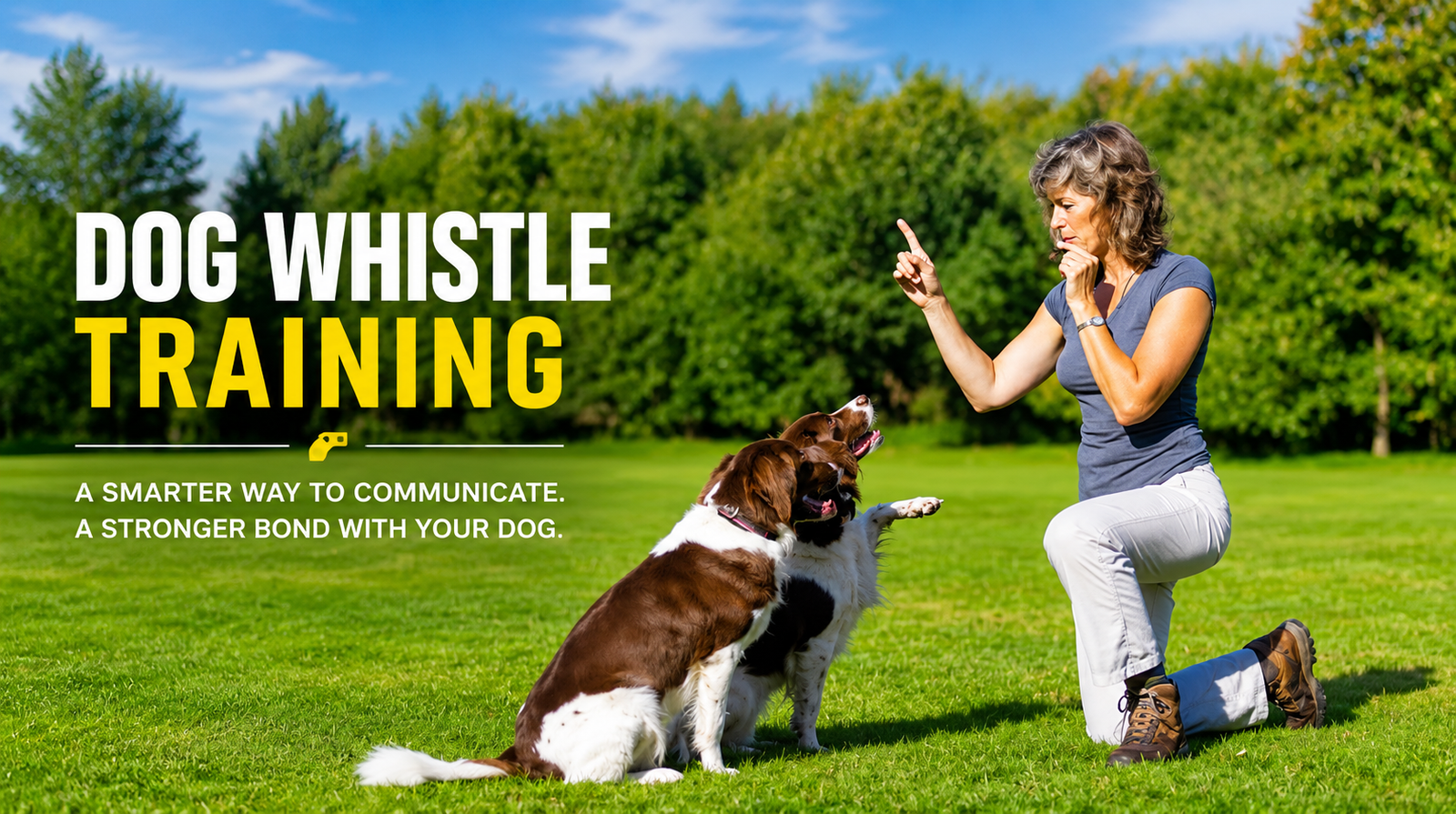
Dog Whistle Training is a practical way to teach dogs clear cues for recall, stopping, staying, and other behaviors, especially when working at a distance. A whistle does not automatically make a dog obey; it becomes meaningful only after its sound is consistently paired with a trained behavior and reward.
For many owners, the biggest advantage is consistency. Your voice can change when you are excited, frustrated, tired, or standing far away, while a whistle can produce a much more consistent cue. This makes it particularly useful for outdoor training, hiking, field work, herding, and dogs that regularly work at a distance from their handlers.
Dog Whistle Training: How Does It Work?
Dog whistle training works by teaching your dog that a particular whistle sound predicts a specific action and, ideally, something rewarding. The whistle is simply another cue, similar to a spoken command or hand signal.
A dog does not naturally know that one whistle means “come here” or that another pattern means “stop.” You have to create that association through repetition.
Start somewhere quiet where your dog can focus. Blow the whistle briefly, then immediately give several small, high-value treats. Repeat this process with plenty of space between repetitions.
At this stage, you are not asking for a complicated behavior. You are teaching your dog that the sound has a positive meaning.
Once your dog consistently reacts to the sound by looking toward you or becoming attentive, you can begin connecting the whistle to a behavior your dog already knows.
For example, if your dog already understands “come,” you can blow the whistle, say “come,” and reward the dog generously when they reach you. With repetition, the whistle can gradually become the cue that starts the recall.
The important point is simple: the whistle is a communication tool, not a shortcut around training.
Essential Dog Whistle Commands
There is no universal whistle language that every dog automatically understands. You choose the patterns and teach your dog what each one means.
| Whistle Cue | Possible Meaning |
| Several short blasts | Recall or come |
| One long blast | Stop or attention |
| A specific repeated pattern | Stay or hold position |
| Different tones or patterns | Different behaviors or individual dogs |
The exact pattern matters less than consistency. If one whistle means recall today but something different tomorrow, your dog has little reason to respond reliably.
For working or herding dogs, handlers may use different whistle patterns for movement, stopping, or directional work. Dogs can learn to distinguish between cues when each sound is consistently paired with a particular behavior.
For a family pet, you do not need a complicated whistle vocabulary. One clear recall pattern may be enough for everyday use. If you later need additional commands, introduce them one at a time rather than teaching several new sounds simultaneously.
How to Teach a Dog Whistle Recall
Recall is one of the most useful applications of a whistle because the sound can carry across an outdoor space and provide a consistent cue when your normal speaking voice is difficult to hear.
Begin indoors or in a secure, low-distraction area. If your dog already responds reliably to “come,” pair the whistle with that established behavior.
A simple progression looks like this:
- Blow your chosen recall whistle.
- Immediately give the verbal “come” cue.
- When your dog reaches you, reward generously.
- Repeat until the whistle starts predicting the recall.
- Gradually reduce your reliance on the verbal cue.
- Increase distance only when your dog responds consistently.
- Add distractions slowly rather than all at once.
Do not test a new whistle cue in an open area where your dog could run away. A secure yard, fenced field, or long training line can give you greater control while your dog is still learning.
Once your dog responds reliably nearby, move farther away. Then introduce mild distractions, such as toys or another person at a distance. Eventually, you can practice in more challenging outdoor environments.
Remember that recall is a behavior that needs maintenance. Even a well-trained dog may struggle when faced with an extremely exciting distraction, another animal, or an unfamiliar environment. Continuing to reward good responses helps keep the behavior strong.
Building a Reliable Recall Step by Step
One of the biggest mistakes owners make is moving from a quiet living room directly to an uncontrolled park.
Instead, think of recall as a ladder. Each training level should be slightly more difficult than the one before it.
Level one: Your dog responds inside the home.
Level two: Your dog responds in a fenced yard.
Level three: You add a little distance.
Level four: You introduce mild distractions.
Level five: You practice outdoors using appropriate safety controls.
Level six: You gradually work around stronger distractions.
If your dog stops responding at one level, go back to an easier stage. This is not failure. It simply tells you that the previous step needs more practice.
A reliable recall is built through many successful repetitions rather than a handful of dramatic tests.
Using Positive Reinforcement
Rewards are an important part of successful whistle training. Food, toys, praise, play, or another reward your dog genuinely values can strengthen the connection between the whistle and the desired behavior.
Timing matters too. The reward should follow the correct behavior quickly enough for your dog to understand what earned it.
For recall, make returning to you worthwhile. If your dog comes back after hearing the whistle and immediately loses access to something enjoyable every time, they may become less enthusiastic about returning.
This does not mean you should reward every behavior with food forever. As training becomes reliable, you can vary the rewards. Sometimes the reward can be praise, a toy, play, or permission to continue exploring.
The goal is to create a history in which responding to the whistle has consistently produced positive outcomes.
Why Use a Whistle Instead of Your Voice?
The main benefit of a whistle is clear communication over distance. A whistle can provide a consistent sound across an outdoor area, whereas your voice may become difficult to hear because of wind, distance, or background noise.
A whistle also reduces emotional variation. Your voice may sound completely different when you are worried or annoyed, but a practiced whistle pattern can remain relatively consistent.
This can be particularly useful for hiking, field training, hunting, herding, and dog sports where the dog may be well away from the handler.
Another advantage is that a whistle can help multiple people use the same cue. Family members may pronounce a verbal command differently, but a consistent whistle pattern is easier to standardize.
For basic household obedience, however, a whistle is not essential. A dog can learn excellent manners using verbal cues, hand signals, or other reward-based methods.
Dog Whistle Training for Outdoor Adventures
Whistle training can be especially useful for dogs that regularly spend time outdoors.
Imagine your dog is exploring a large fenced field. Calling repeatedly may become tiring, particularly if there is wind or other background noise. A previously trained whistle recall gives you another way to communicate.
However, owners should not confuse a trained recall with guaranteed control.
Before allowing a dog off leash, consider the environment, local rules, traffic, wildlife, other dogs, and your dog’s individual behavior. A whistle does not prevent a dog from making an unsafe decision.
For hiking and open spaces, recall training should be combined with sensible safety practices. A long line can provide an additional layer of control while you are developing reliability.
Common Dog Whistle Training Mistakes
One common mistake is assuming the whistle is a magic recall device. It is not. Your dog must learn what the sound means through training.
Another mistake is increasing distance too quickly. If your dog responds perfectly in the kitchen but ignores the whistle at a busy park, the environment is simply more difficult.
Avoid changing whistle patterns randomly. Choose a simple system and make sure everyone who trains the dog uses the same cues.
Repeatedly blowing the whistle when your dog does not respond is another poor habit. If you continue producing the same sound without consequences or reinforcement, the cue can lose its importance.
Instead, make the exercise easier. Move closer, reduce distractions, use a better reward, and try again.
You should also avoid using the recall whistle only when something enjoyable is ending. If every whistle means “come back so the walk is over,” your dog may eventually hesitate.
Whenever practical, call your dog, reward them, and then allow them to return to exploring or playing. This teaches them that coming back does not always mean the fun is finished.
Choosing the Right Dog Whistle
Dog whistles come in different designs, frequencies, and styles. Some are audible to humans, while others are marketed as silent or ultrasonic because their sound is above the typical human hearing range.
For most owners, the best choice is one that is comfortable to use and produces a consistent sound. If you cannot reliably reproduce the cue, training becomes harder.
Durability can also matter if you plan to use the whistle outdoors. A whistle that is easy to carry, clean, and use consistently is generally more practical than one that stays at home.
You should also consider how the sound affects your dog. Avoid extremely loud blasts, especially at close range.
A whistle should make communication easier, not create discomfort.
Can Every Dog Learn Whistle Commands?
Most dogs can learn an association between a sound and a behavior, but individual results vary.
Age does not automatically prevent learning. Older dogs can learn new cues, although they may need more repetitions and carefully controlled training sessions.
Breed and personality can influence training style as well. Some dogs are naturally highly motivated by movement, food, toys, or interaction, while others may need more patience to discover what reward works best for them.
Hearing ability is another important consideration. If a dog has hearing impairment, traditional whistle training may not be appropriate. In such cases, visual cues, hand signals, or other communication methods may be more useful.
How to Make Whistle Training More Effective
Keep training sessions short enough that your dog remains interested. Several brief sessions can be more productive than one long session where the dog becomes tired or distracted.
Use a consistent whistle pattern and avoid introducing unnecessary variations.
Reward the behavior you want. If your dog comes quickly, make that response valuable. If they move slowly, avoid turning the exercise into a stressful confrontation.
Most importantly, practice in different environments. Dogs do not always automatically transfer a behavior learned in one location to another.
A dog that recalls perfectly in the backyard may need additional training at the beach, on a hiking trail, or in a busy field.
How Long Does Dog Whistle Training Take?
There is no fixed training timeline because dogs learn at different speeds. The first goal should be recognition of the whistle, followed by a reliable response in easy environments.
Some dogs may begin responding to an association quickly, while dependable recall around distractions can take considerably longer.
Keep sessions short and successful. Once your dog responds consistently, gradually introduce distance, distractions, and more challenging outdoor settings.
Do not judge progress only by how quickly your dog learns the sound. Reliability is more important than speed.
The goal is not simply getting your dog to react to a whistle. The goal is creating a dependable communication system that your dog understands.
Dog Whistle Safety Tips
Responsible use is essential. A whistle may be small, but producing a very loud sound close to a dog’s ears can cause discomfort.
Never deliberately blow a whistle directly beside your dog’s ears. Keep a sensible distance and use the lowest practical volume for the environment.
Watch your dog’s body language during training. If they repeatedly move away, flatten their ears, appear distressed, or show other signs of discomfort, stop and reassess the training approach.
A whistle should make communication easier, not create discomfort. For additional guidance on choosing and using a whistle safely, see the American Kennel Club’s guide to dog whistles
Whistle training should remain a positive learning experience.
It is also worth remembering that dogs have different hearing abilities and sensitivities. What seems comfortable to one dog may not be comfortable for another.
FAQs
Does dog whistle training really work?
Yes, but the whistle itself does not teach obedience. It works when the sound is consistently paired with a behavior and reinforcement.
How do I train my dog to come to a whistle?
Pair the whistle with a known recall cue, reward your dog every time they return, and slowly increase distance and distractions.
What is the best whistle command for recall?
There is no single universal recall pattern. Choose a distinctive pattern and use it consistently.
Can an older dog learn whistle commands?
Yes. Older dogs can learn new cues when training is gradual, clear, and rewarding.
Is a dog whistle safe?
Generally, whistles can be used safely when handled responsibly. Avoid extremely loud blasts close to your dog’s ears.
Can a whistle replace verbal commands?
It can replace some verbal cues after the dog has learned what the whistle pattern means, but there is no need to eliminate verbal commands completely.
Is whistle training useful for dogs that run off?
It can help build a stronger recall, but owners should first practice in secure environments. A whistle should not be treated as a guarantee that a dog will return in every situation.
Can I use different whistle sounds for different commands?
Yes. Different patterns, durations, or tones can be conditioned to different behaviors. Consistency is the key.
What should I do if my dog ignores the whistle?
Reduce distractions and distance, return to an easier training stage, and reward successful responses. Avoid repeatedly blowing the whistle without reinforcing the correct behavior.
Should I use a whistle for every training command?
No. A whistle is simply another communication method. Many dogs can learn effectively with a combination of verbal commands, hand signals, and whistle cues.
Must read our other blogs:
Dog Training Books: The Ultimate Guide to Choosing the Right Book for a Well-Trained Dog